
Unexplainable astronomy? Part 2: Of pigeons and cosmic uniformity

By Sam Jarman

Ask just about any scientist, and they will tell you that the very best discoveries they can make are the ones which force us to change how we think about the world completely. That’s exactly what happened in 1923, when Edwin Hubble looked out at a small, hazy nebula from his mountaintop telescope in California.

Without Henrietta Leavitt’s work, we might still think of galaxies like Andromeda as funny-looking nebulae which don’t make any sense | Image: NASA

Based on previous research by Henrietta Leavitt, Hubble was looking for Cepheid variable stars in the nebula, which would tell him exactly how far away it was. He managed to find a variable star easily enough, but it revealed a pretty big problem. The star showed Hubble that the nebula he was looking at was not even a nebula after all, but a vast cluster of stars situated very, very far away.

The distance was greater than any we had thought possible for thousands of years. For scientists, that meant that we needed to completely rethink our model for the structure of the universe. With the discovery of the Andromeda galaxy, the fundamental idea of billions of galaxies occupying a vast, ever-expanding universe was born. It was a lot for the world of astronomy to take in.

In the decades following Hubble’s discovery, theoretical physicists struggled to discern the scientific rules which could possibly govern such a newly colossal, mysterious universe. Some of their theories seemed promising, but In the meantime, the imaginations of the media and the public ran wild. If our understanding of the universe could be so shaken by one discovery like Hubble’s, they reasoned, what other revelations could be hiding in plain sight? And, of course, the biggest question: could intelligent life be out there somewhere?

Apprehension had grown strong by the 60s. Theoretical physicists had some convincing ideas about the nature of the universe, but at the time, technology just wasn’t sophisticated enough to prove experimentally which were correct, and which were misguided. Their ideas so often disagreed with each other that it seemed like no-one had really got anywhere at all. But change was coming. Improved telescopes meant that by 1964, mysterious signals, the likes of which would make or break previously speculative cosmological theories, began to come in.

A dodgy radio receiver? 

Pigeons. It had to be. Since making their home in the cosy hovel that was the Holmdel Horn Antenna, the birds had been busy and painting the walls with the remains of their dinner, which was giving off who knows what kind of radiation. How else could radio astronomers Arno Penzias and Robert Woodrow Wilson explain the uniform, unwanted microwave signal, which wouldn’t go away no matter where in the sky they pointed the telescope?

Whenever you’re feeling down, just remember that a sad metal toilet in New Jersey once became one of the most important telescopes of the 20th century| Image: NASA

The pair cleared out the avian intruders, and scrubbed the inner surface of the antenna clean. They checked the equipment thoroughly yet again, making sure the receiver was still cooled to just above absolute zero, minimising any interference from within the telescope. But still, the low, intense noise hindering their experiment persisted. Clearly, the radiation was originating from something more interesting than pigeon droppings. Something, they realised, beyond our own galaxy.

Coinciding with Penzias and Wilson’s predicament, a group of astrophysicists at Princeton University were working on a theory they believed could explain what was happening in the earliest moments of the universe’s existence. Based on earlier work by cosmologist Ralph Alpher, their idea hinged on the concept that the universe had all started with a rapid, high-energy expansion from a single point: a Big Bang. They proposed that if the Big Bang had really happened, it must have released a colossal surge of radiation, still observable to this day with the right equipment. The radiation would have cooled significantly by now, but if its remnants were detected, it would be definitive proof that the scientists’ notion was correct.

The idea was in direct conflict with the earlier-proposed Steady State theory, which suggested that the universe had no beginning, meaning no Big Bang, at all. Instead, the universe had existed for an eternity beforehand, and had never changed significantly. The two theories were radically different, and both appeared to have equal weight. But without any hard evidence, neither could be validated over the other. That all changed in 1964, when Penzias and Wilson caught word of the Princeton scientists’ research.

The Colossal Clang and Tremendous Toot were also considered, but never really caught on| Image: NASA/WMAP Science Team

Through a friend, Penzias got access to a preview of the Princeton paper. What he read astounded him: using first principles, the astrophysicists had argued that a surge of electromagnetic radiation had permeated the entire universe following the Big Bang. As the universe expanded, so too did the wavelength of the radiation, until reaching its current wavelength of 7.35 cm. That was the very same radiation Penzias and Wilson had attributed to pigeon poop – almost exactly. The pair got in touch with the Princeton scientists as soon as they could.

The rest of the story is history. The two groups teamed up to publish not only a theory of how the Big Bang could have hypothetically played out, but indisputable experimental proof of the Big Bang itself on top of it. The Steady State theory had been disproved, and was consigned to history. In 1975, Penzias and Wilson earned a Nobel Prize for their ground-breaking discovery.

Decades later, the radiation observed for the first time by Penzias and Wilson – now known as Cosmic Background Radiation – has been studied in meticulous detail. It has been found to be incredibly uniform, but not perfectly so. In the very earliest moments of the universe, some regions emerged where matter was densely clumped together, whereas it was sparser in others. As the regions formed, the surge of radiation created by the Big Bang was slightly distorted by the clumps of matter.

Of all the scientific results which were first thought to be literally crap, the Cosmic Microwave Background has got to be the most impressive | Image: NASA

Billions of years later, the denser regions have become areas abundant in galaxies, while the sparser regions are now vast, empty voids in space. The Cosmic Microwave Background has retained the distortion it underwent at the very start. By picking up the subtle variations in the radiation, we can now create maps of the structure of the universe with detail which must have been unthinkable just a few decades ago.

So from a mysterious error first attributed to pigeons with poor housekeeping skills, came another fundamental theory in cosmology. But the 60s weren’t over, and there were yet to be more discoveries which would prove to shake up our understanding of how the universe works. In 1967 came another bizarre signal, this time with a somewhat more exciting misguided idea about where it came from.
G is for Gravity Waves

By Jonathan Farrow from the Thoughtful Pharaoh

Deep in Antarctica, right on top of the geographic South Pole, there is a research station that peers back in time to the very beginning of our universe. Named the Amundsen-Scott Station, it is home to instruments such as the creatively named South Pole Telescope (SPT), the Keck Array, and the BICEP experiments.

The temperature is currently sitting at about -30C and it’s the height of summer.  The sun won’t set at the station until March 23rd and once it sets, it won’t rise again until September.  So why the heck (or, one might say…Keck) would we build an observatory there?

Because the temperature is so low and the altitude is so high (2743m) at the South Pole, the air is thin and dry, reducing blurriness normally caused by the atmosphere.  There are no cities nearby to cause light pollution and there are months of nonstop night, allowing for continuous observation.  It’s an astronomer’s dream.  Except the nearly-constant -30C temperatures.  And the remoteness.  But otherwise, dreamlike.

Damn that looks cold! Photo from 2003
The perfect place to set up a top-secret laboratory from which to take over the world!… I mean… uh… from which to observe the beginnings of the universe.  Yeah, that’s what we’re doing.  Definitely that.  Image credit: NASA

So what are astronomers looking for all the way down there at the end of the world?  They are searching for clues as to how the universe started.  Ever heard of the Big Bang Theory?  No, not these clowns, the theory about the beginnings of the universe. Although, come to think of it, the theory is actually pretty well summed up by the first line of the Barenaked Ladies’ theme song to the Big Bang Theory (yes, those clowns):

Our whole universe was in a hot dense state,
Then nearly fourteen billion years ago expansion started. Wait…

That’s really the core of the theory:  everything used to be really hot and dense and now its not.  What happened in between is what the astronomers at the South Pole are trying to figure out.

History of Universe
For a bit of a primer on this diagram, check out A Short History of (The Universe), an essay I wrote which introduces the origins of the universe.  Image by NASA

Astronomy is awesome because when we look up, we are actually looking back in time.  The distances involved are so great that it can take years (or billions of years) for light to reach us.  So, what if we just looked as far as we could, wouldn’t we be able to see the Big Bang happening?  What would that even look like?

Unfortunately, because everything was so hot and dense right at the start of the universe, nothing could stick together so the universe was just a soup of energetic particles.  Any light that was emitted was bounced around like the light from a flashlight in thick fog.  About 380 000 years after the Big Bang , the universe had cooled and expanded enough to let atoms form and collect electrons.  Atoms are mostly empty space, which means that unless they are packed very close together like in a solid or liquid, they are transparent.  What resulted was light spreading pretty evenly throughout the universe, starting 13.7996 billion years ago.  This is what is called the Cosmic Microwave Background Radiation (CMBR).  Cosmic because it comes from space, Microwave because it has lost a lot of energy since the Big Bang and is now only 2.7 degrees above absolute zero, Background because it is there no matter which direction you look, and Radiation because it is light.

WMAP
A map of the Cosmic Microwave Background Radiation. The different colours represent slight anomalies (about 10^-5 degrees C difference). Red is a little bit hotter, dark blue is a little bit colder.  Image by NASA

So, no matter how far you try to look, this map is all that you see.  It is all that can be seen because it is the oldest light that escaped.  Sounds kind of disappointing, but astronomers think that that image (what some refer to as the baby picture of the universe) holds clues to what happened before.

If there was inflation, faster-than-light expansion of space and time (again, check out my essay on the history of the universe if you’re confused), that process should have produced gravitational waves.

“Woah, woah, woah.  Hold up.  I understand gravity, apples falling on heads, etc etc…  How the Keck could there be gravity waves?”

One of Einstein’s key contributions to science was the understanding that space and time are linked and that they are influenced by mass.  He described space-time as a fabric that could be warped by the presence of mass.  All that gravity is, he said, is the curvature of space-time around mass.  A simplified way to understand this is by thinking of space-time as a trampoline.  If you put a mass on the trampoline, it will create a depression.  The heavier the mass, the more extreme the depression.  Now, if you have an extreme depression and move it very quickly back and forth, it will create waves in the same way that a moving hand in a pool will create waves.  Astronomers think that inflation must have created gravity waves with a very specific signature. They also think that very heavy stars moving quickly, like binary neutrino stars, would create these gravitational waves.

Loooook into my gravity waaaaves.  You are not getting sleepy.  You are paying attention, commenting below, and sharing this with your friends.
Loooook into my gravity waaaaves. You are not getting sleepy. You are paying attention, commenting below, and sharing this with your friends.  Image by NASA

If (or, once they are discovered for sure, when) gravity waves pass through you, it is space itself which is expanding and contracting.  You are not moving, but as the wave passes through your arm, your arm will be closer to your body than it was before and time for it will move slower.

The thing about gravity, though, is that it is by far the weakest of the fundamental interactions (Electromagnetic, Weak, Strong being the other, stronger ones).  By a factor of about a nonillion (1 with 30 zeroes after it).  This makes the waves it creates very difficult to detect.  While your arm is probably having a taste of timelordery as you read this, there is no way you could possibly feel it.  Gravity waves are not interesting for how they make us feel, but rather for the challenge they present in detecting, for the possible confirmation of our current physical model, and for what they can tell us about the origin of the universe.

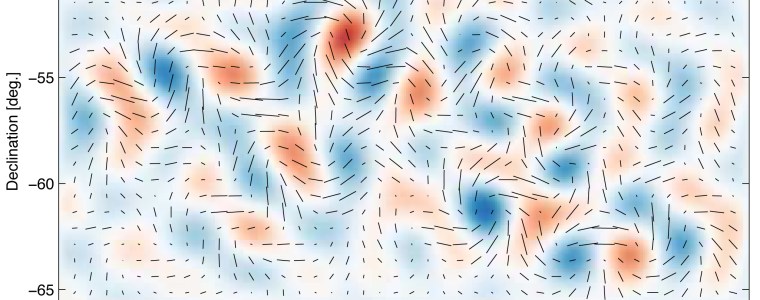
So let’s come back back to the barren, frigid wasteland of Antarctica and the astronomers freezing their buns off for science.  BICEP2, the second iteration of the Background Imaging of Cosmic Extragalactic Polarization experiment, looked at the CMBR and looked for patterns in the light.  These patterns, called b-mode polarization, can be produced by gravity waves, but also by interstellar dust.

In order to cancel out the effect of dust, the BICEP2 team used data from Planck, a European satellite launched in 2009 with a very similar mission: to study the early universe.  Whereas BICEP2 could only look at one particular wavelength with high sensitivity, Planck could look in a few different wavelengths but didn’t have quite as much sensitivity for these b-modes.  Dust doesn’t leave the same polarization patterns in light in different wavelengths, so by comparing the results from different wavelengths from Planck, the BICEP2 team was able to show that the b-modes weren’t from dust and so had to be from gravity waves from the early universe.  Proof of inflation!  Proof of the standard model! A possible Nobel Prize!

./b_over_b_rect.eps
Those swirls are the b-mode polarization that astronomers were looking for.  This diagram, while confusing as Keck (it’s going to catch on!) and quite complicated, was EVERYWHERE when the announcement was made.  Image by BICEP2 team

So, understandably excited and with a positive result in hand, there was a big announcement at the Harvard-Smithsonian in March of last year.  Unfortunately, the data they used was preliminary.  In September, new data was released and the effect of dust seems to have been larger than they thought.  The team reduced the confidence in their findings but still stood by a significant result.  Just last month, in January 2015, another set of data was released that makes the BICEP2 findings inconclusive.

It seems the team jumped the gun a little bit, were blinded by the impact of their apparent discovery, and had too much confidence in preliminary data. The result of all this is that there is still no direct evidence of inflation or of gravitational waves and the teams at Planck and BICEP are going to work together now with the strengths of their instruments.  Within a few years, the effect of dust should be able to be cancelled out and we will be able to see whether we were right about the beginning of the universe.  And all the frostbite will have been worth it.