A is for Atom

By Siobhan Fairgreaves

Never trust an atom- they make up everything!

Scanning Tunnelling Microscopy can give us incredible images like this one of a piece of graphite, showing how its atoms fit together like Lego. Luckily, treading on atoms isn’t like treading on actual Lego, or walking would be incredibly painful | Image: Frank Trixler

Terrible jokes are finished, for now…


In this post, we will look at the basic structure of the atom. But first, what are atoms?

Atoms are the building blocks of the world- think of Lego. If the whole world was made of Lego an atom is that tiny single square block. Imagine how many of those tiny blocks would be needed to build the whole world and all the people, animals and stuff inside it… That’s a lot of Lego, and there are a lot of atoms. A single grain of sand contains millions of these tiny particles.

For a long time atoms were thought to be the smallest piece of the puzzle. Then in 1897 a scientist named J.J. Thomson identified an even smaller particle which helps to make an atom.

Cheer up J.J., you’ve revolutionised modern physics! | Image: Benjamin Crowell

Thomson made the discovery when he was experimenting with mysterious beams of particles called cathode rays. When firing cathode rays at hydrogen atoms, he measured how the path of the beams changed as they interacted with the atoms. Thomson realised that the cathode rays were made of tiny, negatively charged particles – around 1/2000th the size of a hydrogen atom. He named the particles ‘corpuscles’, but we know them today as electrons. But Thomson’s discovery doesn’t tell the whole story about what we came to know about the atomic structure.

In fact, we have another scientist to thank for that. In 1909, New Zealander physicist Ernest Rutherford fired some positively charged radioactive particles through a sheet of gold atoms, and measured the different paths they took. He was testing out J.J. Thomson’s ‘plum pudding’ model, which proposed that atoms were made up of electrons sitting happily inside a positive sphere, holding them together.

Thanks to Ernest Rutherford, scientists can now study atoms without constantly thinking about delicious desserts | Image: Library of Congress

Rutherford noticed that most of the particles passed straight through the atoms, but a tiny proportion were deflected back. That meant that instead of being plum puddings, each atom was made up of a small positive nucleus, surrounded by orbiting electrons, with lots of empty space between them. And so, the basic model for  an atom was born!

A typical illustration of an atom will show a ball in the middle surrounded by orbits- but what is going on in there? The ball in the middle is the nucleus which Rutherford discovered, and inside the nucleus are protons and neutrons. The things whizzing round the outside are the electrons. Protons, neutrons and electrons are known as sub-atomic particles, now that’s an impressive dinner party phrase.

Electrons in different energy levels form a cloud of negative charge around the nucleus| Image: Mets501

It might look like electrons are in a messy, complicated cloud but they are actually very precisely arranged. Around each nucleus are different shells, or energy levels, which have space for a different number of electrons.


The very first energy level around the nucleus can only hold 2 electrons. In an atom of the element Helium both of the spaces in the first energy level are filled by an electron. So, using Helium as an example, what else is in there? To work that out you should know that it is really important for an atom to be balanced. Each electron carries a negative charge so to balance Helium we now need two positive charges. Fortunately, protons have a positive charge each. So we’ve got two negative electrons whizzing around the outside, two positive protons snug in the nucleus, the charges are balanced. So, are we finished?

It might seem fun to try and chop a uranium nucleus in half, but it’s not actually a very good idea… | Image: Scienities

Almost, don’t forget the third component, neutrons. Luckily, they are- you guessed it- neutral, so it’s okay for the number of them to vary between different forms of the same element.  Most of the time, Helium has two neutrons and with two of everything it is nicely balanced and known as stable.

Helium is a nice example with small numbers but not all elements are quite so compact. Take Uranium, for example, there are a lot more protons (92!) and electrons involved to try and get Uranium to balance.

That’s a very basic introduction to atoms- and for sticking with it, you’ve earned yourself another terrible joke! What a treat…

A neutron walked into a bar and asked for a drink.

“How much?” asked the neutron.

The bartender replied, “For you, no charge!”

Hopefully, that joke will make a bit more sense now you know your stuff about subatomic particles and their charges.

Until next time!
Lionfish wreak havoc on marine ecosystems

By Roisin McDonough

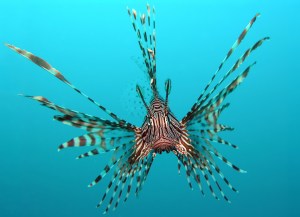
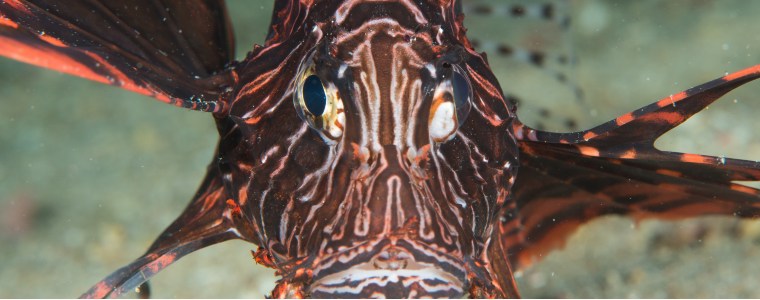
Look at me. I’m the top predator now. | Image: Jens Petersen

The lionfish, beautiful in appearance and un-problematic in their native regions of the Indo-Pacific have wreaked havoc as an invasive species in the Atlantic; having become well established  in the Southeast coast of the US, the Gulf of Mexico and the Caribbean.

The Lionfish invasion was likely caused by humans releasing this popular ornamental fish from home aquariums when they were no longer wanted (over the course of 25 years). Their journey to the Atlantic was then possibly aided by the warm Gulf Stream  current which dispersed buoyant lionfish eggs and larvae further afield.

Warm currents like the Gulf Stream could be letting lionfish blag a cheeky ride to where they aren’t welcome | Image: Sommerstoffel

At first, their arrival into new areas was not considered to be much of a problem, as it was thought that that they would not survive very long. However, over the years, the lionfish have not just survived, they have thrived. Their success has led to the unfortunate and worrying decline of many native fish species and an alteration in the very delicate reef ecosystem.

Lionfish out-compete, out-live and out-breed native fish. But why?  For starters, they are highly tolerant to a range of temperatures, salinities and depths and biologically resistant to most diseases and parasites that affect native fish. Further, they have very few, if any, natural predators in the Atlantic. They become sexually mature at 1 year of age and can live in excess of 15, so have a long, rich reproductive life. In optimal conditions, females can release a staggering 2,000,000 eggs per year!

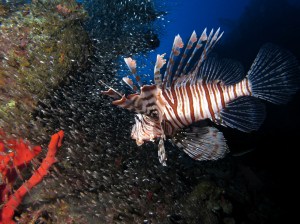
“Do you think that new guy looks dangerous?” “Who, the grumpy looking stripy one who’s at least 1000 times bigger than the rest of us?” “Yeah” “Nah, there’s something about his vast, leafy appendages I find sort of… comforting” | Image: Alexander Vasenin

Lionfish are un-selective carnivores with voracious feeding habits, encompassing a huge range of small fish and crustaceans. Included in their diets are popular commercial fish like grouper and snapper and commercially important crustaceans such as lobster, crab and squid. In their non-native environments they have easy pickings when it comes to food, as generally, native species do not recognise the lion fish as a threat. In fact, some small fish will assemble around these invasive creatures in the hope that their fin rays/feathery pectoral fins will provide them with shelter and protection.

So far, lionfish hunting  seems to be the only feasible method of controlling their numbers. Certain areas which are regularly hunted see an increase in the number of native fish over time. However, the areas that can be reached by lionfish hunters is very small in relation to the vast marine environment lionfish now cover.

Invasive lionfish populations are an ever-growing problem – native marine life has suffered dramatic reductions as a result of their predation. Commercial fisheries, recreational activities and food security have also all been negatively affected as a consequence. We do not know the extent of the devastation to marine habitats in the near future, but it is likely to be bleak if their populations are not controlled.

Touch nature

By Jonathan Farrow from the Thoughtful Pharaoh

I touched a rhinoceros yesterday; it was pretty awesome.

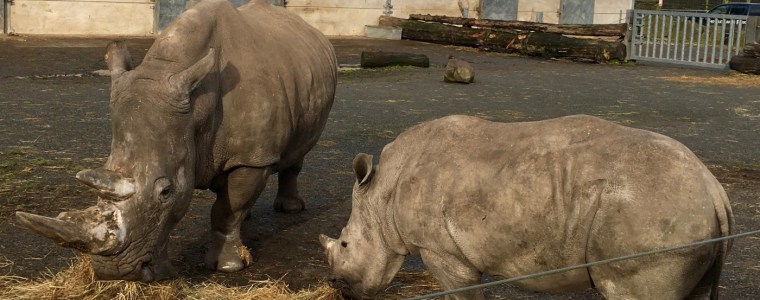
A real, live rhinoceros. His name is Shaka.

Shaka (1).jpg
Me and Shaka are basically best friends now. | Image: My own.

He was big, warm, rough, and surprisingly docile. He seemed gentle and easygoing, but I was also warned that it’s basically impossible to stop a rhino from doing what it wants to do.

I also met Shaka’s daughter Nomvula and his baby mama Meru and now I’m in love with rhinoceroses.

Baby rhino and mom.jpg
I love rhinos. Rhinos love hay. Does that mean I love hay now? | Image: My own

I had the privilege of getting up close and personal with a rhino yesterday because I have a friend who works at Knowsley Safari, near Liverpool. My friend introduced me to the rhinos’ keeper, Jason, who spent half an hour with us, telling us all about rhino physiology, rhino breeding programs, rhino behaviour, and about the personalities of the Knowsley rhinos.

I learned that the name White Rhino is probably a mishearing of the dutch wijd, referring to their wide mouths (although some parts of the internet disagree). I learned that the horns were probably once used to dig up tubers and aren’t usually used in fights. I learned that it takes five years before a rhino trusts you enough to tolerate you.

It was all supremely interesting, but the thing that stuck with me most and the thing I want to write about is the feeling of touching a wild animal.

Connecting with nature

Actually meeting a rhino connected me to them in a new way. I had read about poaching issues, about the price of rhino horn, about conservation programs. But it all seemed so remote. I cared, but I didn’t really care.

This sense of connection after exposure has been shown with nature more generally: the more time you spend in natural environments, the more likely you are to care about nature and the more likely you are to do things that help it.

Most people tend to appreciate nature already, but there are plenty of selfish reasons to take yourself outside more often. Connection with nature is associated with decreased rates of depression, increased intelligence and faster recovery rates in hospital. People who live close to green space are healthier – physically and mentally.

Because of this, some researchers argue that encouraging people to protect the environment would be a solid public health policy.

Social Psychology

So, now knowing all these facts about the benefit of nature, why did it take actually touching a rhino for me to feel connected with nature? There are probably lots of reasons, but I think there are two interesting answers from social psychology: the mere exposure effect and lessons from prejudice research.

The mere exposure effect is a well-studied phenomenon in psychology. People tend to like what they spend time around. It’s why Justin Bieber gets better the more you listen to him. We like familiarity. In a famous 1968 paper that established the effect, Robert Zajonc presented the results of several experiments. This included one where people preferred nonsense words that they repeat more than ones they only say once.

The intuitive truth of this effect is borne out in the advertising industry. While there are other bits of psychology at play in any given ad, ultimately the more you see a brand, the more you will like it. In the same way, I think the more people are exposed to nature, the more they appreciate it.

But this doesn’t explain why just one amazing encounter with a rhino could have such a deep impact on me, for that we need to take a look at research into inter-group relations.

When two groups hate each other, the way to overcome prejudice is to make meaningful contact between the two groups. This is well-established, but a recent meta-analysis of over 500 papers on the topic looked at why contact reduces tension. The three theories were because it brought increased knowledge of the other group, because it reduced anxiety about the other group, and because it allowed people to have empathy with the other group.

While all three were shown to be valid reasons why contact combats prejudice, the second two had the strongest effects. This makes sense in the rhino context. I could learn all the facts about rhinos, but until I got close to one, I wasn’t sure if they would hurt me and I couldn’t empathize with them. I didn’t care about them.

It’s hard to hurt something you care about.

So get outside and hug a tree more often. If you touch nature, you’ll be healthier, happier, and more likely to do it again. Virtuous circles for the win.

I’ve been doing it wrong

By Jonathan Farrow from the Thoughtful Pharaoh

To rinse or not to rinse. That is the question.

Or, more fully, when you brush your teeth, do you rinse the excess toothpaste out of your mouth with water?

I’d never really thought about this question before Wednesday when a tooth-related incident in my house brought the different tooth-brushing strategies to light. One flatmate, after brushing his teeth, turned the tap on, gathered some water in a cupped hand, and rinsed his mouth out. My other two flatmates were aghast.

“Why are you rinsing!? You’re not supposed to rinse! Jon, get in here, he’s rinsing!”

I ran in to the bathroom and my life changed forever.

**************

Before reading further, take a moment and answer the question. Do you rinse after brushing your teeth, or just spit out the excess toothpaste?

Now that you’ve identified as a rinser or a spitter, prepare to either have your world shaken or to get on the highest horse in the land.

**************

I was surprised by this strong reaction, but I was even more surprised that they had an issue with him rinsing because I’d been rinsing my whole life.

I’m a rinser.

In that moment, I couldn’t believe that I might have been doing something as fundamental as brushing my teeth wrong my whole life. So I did what most 20-somethings with a science blog would do. I got out my laptop and started googling. And I found this official NHS page: How to keep your teeth clean.

It starts off pretty uncontroversial: “Brush your teeth with fluoride toothpaste twice a day for about two minutes to help keep your teeth and mouth healthy.” Great. I do that. So far, so good. But I scrolled down and there was a heading that sent a shiver down my spine.

Don’t rinse with water straight after toothbrushing

“After brushing, spit out any excess toothpaste. Don’t rinse your mouth immediately after brushing, as it will wash away the concentrated fluoride in the remaining toothpaste, thus diluting it and reducing its preventative effects.” Uh oh.

According to several UK sources (like section 2 of this report on Delivering better oral health), I’ve been brushing my teeth wrong my whole life. And there’s a pretty decent chance you have too.

It might just be a British thing, I thought to myself. So I started doing searches for Canadian, American and Australian dental advice.

Canadian advice (like this Canadian Dental Association page on tooth brushing) generally doesn’t say anything about rinsing. Australian advice actually encourages rinsing with mouthwash, something explicitly condemned by the Brits. The Americans are mostly silent on the topic, although I did find an American Dental Association page on mouthwash that implies it’s ok to rinse with mouthwash after brushing, depending on what the bottle says.

So why do Brits care so much about leaving some toothpaste on their teeth?

I have a theory: it’s all about fluoridated water.

Fluoride

The shiny, strong part of a tooth is called enamel, and it’s made mostly of hydroxyapatite. The problem is that in an acidic environment, like your mouth after a cup of coffee, the hydroxy part of the mineral is drawn out and your teeth essentially start to dissolve. Sugar-loving bacteria that live in your mouth also secrete acid as a by-product, which is why sugary foods cause cavities.

But if you put fluoride on your teeth, it can replace the part that the acid dissolved, strengthening your teeth. Fluoride also helps your teeth rebuild and might help kill some of the nasty bacteria. But fluoride can only penetrate a small distance into a tooth, so it’s quite easy to rub off. In order for it to be effective, you need to use it all the time. Twice or more a day, in fact.

To make it easier to get a consistent, low-level exposure to fluoride, governments across the world started adding it to tap water. This was (and continues to be) quite controversial, but if the World Health Organization, Health Canada, expert panels, the CDC and the majority of dentists and scientists agree that it does more good than harm, it’s hard not to be convinced.

The experiment in water fluoridation started in 1945 in the US, with Grand Rapids, Michigan. After 11 years, it was announced that the rate of tooth decay in children in the city had dropped 60% compared to the nearby control city of Muskegon, Michigan.

Canada, where I’m from, got on the fluoride bandwagon pretty early. In the same year that Grand Rapids started its experiment, 1945, Brantford became the first Canadian city to fluoridate water. In due course, they saw the same reductions as their American counterparts. Since then, water fluoridation has taken off. 45% of the Canadian population lives with fluoridated water, with many of the major cities getting on board (Ottawa, Toronto, Hamilton, Winnipeg, Calgary, Edmonton, and Halifax have fluoridated water, Montreal and Vancouver are notable non-fluoridaters).

Water fluoridation is the official policy of the US Public Health Service, so more than two thirds of Americans have fluoride in their tap water. Australia is even stronger on fluoridation, with their rate pushing 70%. Europe, by comparison, barely fluoridates their water. The only 4 countries that have any fluoridation programs are Spain, Serbia, Ireland and the UK, but less than 10% of the population of these countries have that water.

In the UK, most of the fluoridation happens in the North and in the Midlands. In total, about 6 million people have access to fluoridated water in the UK.

To rinse or not to rinse

So what does all this mean for rinsing after brushing?

My theory is that, in places (like the UK) where water fluoridation is rare, health authorities advise people to leave toothpaste on their teeth because toothpaste is the only major source of fluoride. In places where fluoride is abundant in the water, health authorities don’t really care whether you get extra fluoride from brushing your teeth.

I accept that I’m doing it wrong. While I’m living without fluoridated water, I accept that I should probably become a spitter rather than a rinser. After about a week of trying, though, I can tell you that changing a lifelong habit is really hard. There’s probably some interesting science behind that, but I’ll leave it for another time.

Design, Naturally: Lateral lines provide a sixth sense for underwater robots

By Anwen Bowers

More little fish swimming in a school.
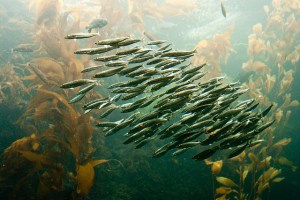
“We turning left now?” “Yeah, you do know we have a sophisticated biological mechanism for finding that out, right?” “I was just asking for a friend” | Image: Tom Thai

Have you ever seen two fish bump into each other?

The underwater world is an assault of sensory signals. Sound, for example from crashing waves, travels over twice as fast in water than it does in air. Smells, ranging from mating hormones to decaying organisms, clash against each other like instruments in an orchestra and would be overwhelming to us if we had noses sensitive enough to detect them. Light is changing constantly, with the different wavelengths becoming increasingly filtered out with depth until animals are left navigating waters so dark that they would be impossible to penetrate with human eyes.

But despite the chaos, fish are able to identify predators, prey and potential mates with lightning reflexes and take the appropriate action within milliseconds.  This is thanks to a super-human sensing mechanism called the lateral line, which gives the fish a sixth sense with which to navigate in their watery habitat.

lateralline
A subtle stripe of hair can tell fish everything they need to know about their environment | Image: Pogrebnoj Alexandroff

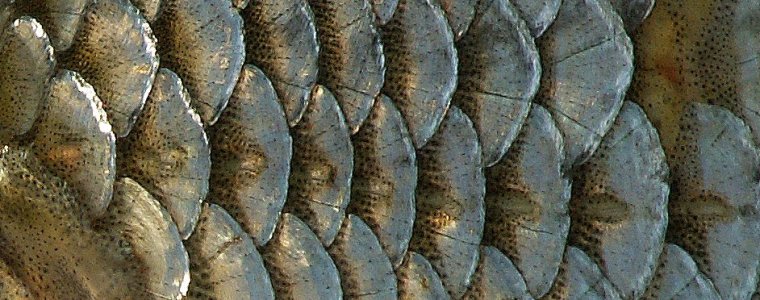
Sometimes visible as a dark strip running along the fish from fin to tail, the lateral line consists of minuscule bundles of hair that can be either attached to the surface of the scales or slightly submerged in channels below the skin. These hairs work similarly to whiskers on a cat, bending in response to any change in the flow of water around the fish. Cells at the base of the hairs then send messages to the brain, containing information on the scale, speed, and direction of the disturbance. This can then be interpreted to give information about the size and shape, and therefore species and likely friendliness, of anything moving in the local area. The ability to identify friend from foe by the flick of its tail is an invaluable tool of survival.

Seas and oceans are one of the least understood habitats on earth, with vast areas being simply too inaccessible to explore. As space on land is becoming rapidly exhausted, we are extending further and deeper into the oceans to source food, generate energy and hunt for new minerals and medicines. Faced with challenges such as the extreme pressure and low temperatures, increasingly we are depending on the work of underwater robots to bring us information on the chemistry, physics, and biology of the deep sea.  Engineers looking to improve the performance and capabilities of these underwater robots have found inspiration in the lateral line to improve the performance of these robots.

robofish
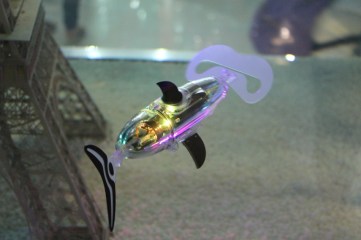
Bass-ta la vista, Ray-by: artificial lateral lines have inspired highly sensitive robotic fish | Image: Titus 140

Researchers in Germany and the US have independently come up with two different systems that recreate the processes that take place in the lateral line hairs. Integrated into underwater robotic technology, these systems could create a robot with much greater perceptions of their surroundings. Traditionally, operators would rely on images from video and sonar to navigate and direct the actions of the robot underwater. Both of these technologies are limited, as they can only provide information on the small area that they are pointing at Imagine only being able to view the world through a toilet roll tube – it’s a bit like that.

Lateral lines could provide a much more detailed 3D picture of the surrounding environment, allowing more informed decisions about how the robot should proceed. The more information available about the surrounding area, including any obstacles, the greater the chance of the robot completing its mission as efficiently and safely as possible. For example, if the battery is running low, the lateral line would be able to identify nearby areas of low water movement where the robot can go to rest and conserve energy out of the current. Taking inspiration from nature, and building robots that can sense like fish, scientists can expect to soon be announcing plenty more exciting discoveries from the mysterious deep ocean.

Introducing Sam Jarman: Editor-at-large for Rising Ape Collective

profile sam jarman rising ape editorVeteran followers will have spotted the uptick in articles published on the RA site in the last couple of weeks. Now he’s got his feet under the WordPress dashboard, we can announce it’s all thanks to the efforts of Sam Jarman, the new editor for Rising Ape Collective.

Sam will be working with our roster of featured writers, including Anwen Bowers and Jon Farrow, as well as writing his own series on unanswered questions in cosmology. He may even be called upon to brutally edit that science poetry Antony keeps threatening us with. If you’d like to be hosted on the site, why not contact Sam about writing for Rising Ape.

We’ll let Sam tell you more about himself in time-honoured, RA style guide mandated, third person:

Having finished a Physics degree, Sam decided he was probably better at writing about science than researching it, and decided to take the lazy noble path of becoming a science journalist. He’s now taking the Science Communication course at UWE in Bristol, where he met the Rising Ape team.

Sam’s biggest interests in science are astrophysics and particle physics, which he likes to try and explain to people (even the parts he doesn’t really understand himself), most likely annoying them in the process. You’d think Brian Cox would be fearing for his job, but unfortunately Sam’s voice just isn’t soothing enough to become a suitable rival.

Sam’s favourite supersymmetric particle: The sstrange squark

Design, Naturally: Precious pearls inspire super-strong glass

By Anwen Bowers

dukeofbuckingham
The Duke of Buckingham’s frankly over-the-top bling held some fascinating material properties. | Image: Art Gallery of South Australia

Take a stroll through almost any art gallery and the cultural value of pearls as a status symbol through time is inescapable. From the intricately laced clothes in Elizabethan portraits to the long strings worn by chic youth in the early 20th century photographs, pearls have been a symbol of wealth and glamour. However, shifts in technological capabilities mean that pearls could soon have a much broader range of uses than being merely decorative.

Starting life as a humble piece of grit, pearls gain their ethereal shimmer from nacre, a biological substance secreted by oysters, which eases the discomfort once grit enters their shells. Nacre is produced by a number of different molluscs, and can also be found inside snail shells and coating mother-of-pearl. This material has long been of interest to materials scientists due to its incredible toughness.

Scanning electron microscopy has been used to reveal that the structure of nacre is similar to that of a brick wall, with “bricks” in the scale of micrometres being glued together by an organic adhesive. The bricks themselves are made of aragonite, a form of calcium carbonate with a similar structure to sea shells.  These bricks overlay each other, and when pressure is applied they are able to slide against each other which prevents the material from snapping. If any cracks form in nacre then the adhesive acts as a barrier, dissipating the energy along the channels between the bricks and preventing the crack from propagating through the material.

aragonite
Layers of aragonite, held together with a natural glue, make up the intricate structure of nacre. New techniques are developing super strong glass from man-made nacre, or ‘facre’ if you will | Image: Fabian Heinemann

This structure gives nacre the very desirable properties of strength and toughness combined, and a number of strategies have been proposed to create a synthetic material that mimics this brick and mortar structure. Most of the proposed methods have involved a “ground up” strategy of assembling component parts, but this has only ever produced materials that have too high a proportion of adhesive and not enough solid bricks. Nacre itself is 95% aragonite, with only a tiny amount of adhesive holding everything together.

TERMS OF USE á   Unless otherwise stated, the Texas Parks and Wildlife Department retains all rights to the image's.  á   The user agrees to be responsible for any claims or liability arising from images of subjects for which there is no model release.  á    A credit line listing the copyright holder, along with photographer's name, if available, must accompany reproductions of the image's.  Permission to publish or otherwise reproduce the image's is granted on a one-time basis only for the purpose stated herein. Usage rights are not transferable from the user-borrower to another user.  User shall not add to, subtract from or otherwise alter an image without written consent from TPWD. Slight cropping and subtle changes in density, contrast and overall color balance do not require approval. For more information regarding our copyright policies go to http://www.tpwd.state.tx.us/site/policies/#copyright.
Take it from the experts: oysters have been making better glass than us for over 100 million years. Still haven’t figured out how to make windows though. | Image: USEPA Environmental Protection Agency

A more recently proposed “top down” method involves a laser which carves into glass and fills the channels with polyurethane glue. This technique has created a material that strongly mimics the properties of nacre. It can be applied to glass or ceramic, both strong materials that are normally limited by their brittleness. By treating them with the polyurethane, scientists have created composite materials that have 700 times the toughness of the original glass!

Biology has been evolving materials for millions of years, to make structures for protection, support, buoyancy, cutting and grinding food, even building organic homes. Whereas slow evolution in the natural world means that each material has tailored properties making it the best choice for different functions, as humans we apply a relatively narrow range of materials to a very broad range of uses. As some materials become depleted, and others face environmental issues, it is vital that we explore other options, and tapping into the wisdom of nature seems like a good place to start.

Space is Big

By Jonathan Farrow from the Thoughtful Pharaoh

I didn’t grow up by the sea, so every time I’m faced with an ocean, I get a true sense of awe. The sheer magnitude of the thing in front of me leaves me speechless. I look out and it’s just water, as far as the eye can see.

File_000.jpeg
Image my own

On a clear day, the horizon for an average person standing by the sea is about 5 kilometres.

So if looking out 5 kilometres in every direction is enough to impress me (and I’m pretty sure I’m not the only one), you can imagine why I love looking through telescopes so much.

The moon, an easy target for amateur astronomers like myself, is nearly a hundred thousand times further away than that horizon (384000 kilometres on average). When you look at it through a telescope, you can see start to identify craters and “seas”, just like Galileo did 400 years ago.

Full moon.jpg
Image by Gregory Revera via Wikimedia

And that’s the closest non-Earthly object in the Universe. It only gets further from there.

Light, travelling at the speed limit of the universe, takes about one second to reach us from the Moon. The Sun, which by coincidence is the same apparent size as the moon when viewed from Earth, is 400 times further away. Light takes 8 minutes to reach us from its tumultuous, fusion-fuelled surface.

It takes light 4 hours to get from the Sun to Neptune, the edge of the Solar System (sorry Pluto, you don’t count anymore). Light travelling for 4 years will just about get to the nearest star (Proxima Centauri) and to get to the edge of the Milky Way from its centre takes light more than a thousand human generations (50000 years +).

While those distances are starting to get mind-boggling, the Milky Way is only one very tiny part of the Universe. Sure, it contains a billion stars and the only known way that the Universe knows itself, but we’re learning that we’re even smaller than we thought.

The next closest galaxy to the Milky Way is called Andromeda, and together with 52 other mini-galaxies, we live in the Local Group.

Local_Group_and_nearest_galaxies.jpg
Image by Antonio Ciccolella via Wikimedia

The Local Group, in turn, is part of a supercluster of galaxies called Virgo. And that was it – our Universal address was Earth, Solar System, Milky Way, Local Group, Virgo Supercluster.

But in 2014, astronomers redrew the map of the local Universe by looking at where galaxies were moving. It turns out that we’re part of a much larger supercluster called Laniakea. The name is apt, meaning ‘immeasurable heaven’ in Hawaiian.

Another recent discovery has shed new light on the size of the universe. In October 2016, astronomers from the University of Nottingham and the University of Edinburgh used data from a new set of Hubble images called Frontier Fields to recount the number of galaxies in the Universe.

The original Hubble Deep Field images, released in 1996, reached further away (and therefore further back in time) than anything previously available. They glimpsed 12-billion-year-old galaxies from the very early Universe.

These Deep Field images had thousands of galaxies in them, so when astronomers extrapolated that out to the whole sky, 120 billion was the agreed number of galaxies in the Universe.

HubbleDeepField.800px.jpg
The original Hubble Deep Field from 1996, Nasa via Wikimedia

But 120 billion galaxies don’t weigh enough, so astronomers suspected that might be a miscount. This new study uses images that go back 13 billion years and used a mass distribution approach to arrive at a new number that would include galaxies too faint to actually observe.

Their results show that there are 2 trillion galaxies in the Universe, 10 times more than previous thought.

Or, at least, there were 2 trillion galaxies. Many of the small, early galaxies will have merged with others in the intervening 13 billion years, but the light from those mergers hasn’t reached up yet.

With astronomers not only redrawing the map but also doing another census, it turns out space was bigger and fuller than we thought.

What does that mean for the awestruck boy by the sea? I’m not entirely sure, but I think it means that even though he’s smaller than he thought, he should keep wondering and keep seeking to understand his place in the Universe. I take a lot of inspiration from Carl Sagan, so I’ll leave you with this, from Cosmos:

“In a cosmic perspective, most human concerns seem insignificant, even petty. And yet our species is young and curious and brave and shows much promise. In the last few millennia, we have made the most astonishing and unexpected discoveries about the Cosmos and our place within it, explorations that are exhilarating to consider. They remind us that humans have evolved to wonder, that understanding is a joy, that knowledge is a prerequisite to survival. I believe our future depends powerfully on how well we understand this Cosmos in which we float like a mote of dust in the morning sky.”

Language is Powerful

By Jonathan Farrow from the Thoughtful Pharaoh

With the election of Donald Trump in November came a torrent of think pieces, op-eds, podcasts, Facebook posts, and tweets. Everyone had something to say and someone to blame. It was Hillary’s fault, it was the Left’s fault, it was Putin’s fault, it was the media’s fault. In trying to understand the election, I was left feeling a bit lost.

How could this happen? How could the American people elect someone like Trump? His policies make no sense, he bragged about sexual assault, he has no political experience. Every day was a new scandal, and yet – he is now the President. I still struggle to understand, but I think some of the most interesting Trump pieces I saw over the past year both came from Evan Puschak (aka the Nerdwriter) and they both analyzed the way Trump uses language.


Word choice matters. Language is powerful.

This isn’t a new idea – George Orwell knew it when he wrote Politics and the English Language – but Puschak’s videos got me thinking: what does science have to say about the influence of language on thought?

So I did a bit of digging and this is what I came up with.

There was a popular theory in the 1940s called Whorfianism (proposed by Benjamin Lee Whorf) that the vocabulary available to people shaped their thoughts. This was supported by ‘facts’ like the oft-quoted (but false) statement that the Inuit have hundreds of words for snow.

The strong form of Whorfianism, that you can only think about things that you have words for, has been refuted. You can think about individual colours, smells, and feelings without having specific words for them. If it were true that thoughts had to have words, we would have a hard time coming up with new words (like glam-ma and YouTuber, two of December 2016’s Oxford English Dictionary additions).

Because of the total academic discrediting of Whorfianism, it became difficult to get funding to do any research linking languages with cognitive processes. In the last couple of decades, however, a weaker form of Whorfianism has arisen and gained some traction.

While language doesn’t determine thinking, it seems to be able to influence it. I’ll leave some links to studies and articles with plenty of examples below, but my favourite is an Australian aboriginal language called Guugu Yimithirr.

In this language, directions like right and left are always replaced by cardinal directions (North/East/South/West), even on small scales. Facing north, a Guugu Yimithirr-speaking woman might lift her eastern hand to pick up an object north of her, before turning to the southwest to switch it to her southeast hand. People who grow up speaking this language must always and instantly be aware of the cardinal directions. The language has created a training regimen that results in an almost supernatural ability to determine direction.

So while language doesn’t necessarily limit thought, it (along with culture and a dozen other factors), does shape it.

With this weaker form of Whorfianism in mind, I wonder whether the emotive language that Trump has been using to such great effect might alter political discourse. If everyone starts playing his game, will language slowly shift be more emotional? Will we become more tuned to the emotional context of language as a result?

Probably not, but it’s interesting to think about.

And here are those links I promised:

American Linguistic Society – Does the language I speak influence the way I think?

Scientific American – Does language shape the way we think?

New York Times – Does your language shape the way you think?

Buzzfeed – The Inuit don’t have 100 words for snow, so why does the myth persist?

Lera Boraditsky – How the languages we speak shape the ways we think

Steven Pinker – What our language habits reveal

Wikipedia – Linguistic relativity, Benjamin Lee Whorf, Language and thought

Lead image by Gary Skidmore

Natural Cycles: Part 1 – The circle of life and waste

By Anwen Bowers

north-pacific-gyre
Circulation patterns in the North Pacific have created a vast plastic continent | Image: Steven Guerrisi

The Great Pacific Garbage Patch is a vast area in the Pacific Ocean where huge amounts of plastic and other slow-to-degrade waste has accumulated over the past half century. Rubbish from all the rivers in North America and Asia gathers here and then becomes trapped by the swirling waters of the North Pacific Subtropical Gyre.

The plastic has nowhere else to go, and so it circles around the oceans, breaking down into smaller and
smaller pieces; small enough to be consumed by the plankton, fish, birds and mammals of the Pacific Ocean. This poses a huge environmental threat, and it is a result of the linear processing of waste that is a uniquely human phenomenon.

In nature, everything is processed in cycles *cue famous Disney soundtrack*. As animals feed, the basic building blocks of life are passed up the food chain, and when the top predators die or defecate, the cycle starts again. Every single atom in our bodies has already passed through a number of incarnations, already been part of an ant or a daisy or a rock, and has the potential to become so again.

vultures
They may look sinister, but vultures are nature’s recyclers; they are vital in many ecosystems | Image: Hugh Lunnon

Many organisms have carved out an ecological niche for themselves facilitating this cycle. Animals like vultures and dung beetles may not have the most glamorous rep, feeding as they do on dung and rotting corpses. But in so doing they remove a source of harmful bacteria and disease, turning it instead into bioavailable nutrients, promoting growth, habitat, and life. Unglamorous it may be, but an invaluable service nonetheless.

Where nature operates on complex, closed systems that generate zero waste, humanity tends to operate on a linear system. In this system, materials are processed into products that are useful for a time, but once they reach the end of their life span the waste is packed into crevices in the earth’s crust, or swept into oceans, never to be useful again.

This is unsustainable not only because these endpoints will eventually become saturated, but also because by taking the materials out of circulation, we are effectively putting an end to their reincarnation cycle. The more stuff that is floating in the Great Pacific Garbage Patch, the less stuff we have to use, and logic follows that we will eventually run out.

caviar
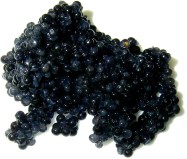
Turning empty cardboard boxes into gourmet dishes: restaurants could have a lot to gain from the circle of life | Image: Lebensmittelfotos

Luckily, more and more business models are starting to see that that by following nature’s example they can simultaneously increase productivity, whilst decreasing harmful output. Cardboard to Caviar is an initiative set up by the Green Business Network (GBN) in West Yorkshire. Inspired initially by the problem of waste cardboard packaging from the restaurant industry, GBN’s solution was to collect the cardboard, shred it and sell it as bedding for horses.

A good solution, but what about the waste that then came from the stables? GBN started to collect that too, feeding it into giant composters, where the cardboard and manure were broken down by worms. The worms, in turn, are fed into GBN’s fish farm, where they are eaten by sturgeon, which produce caviar that is sold…to the restaurant industry!  

The number of businesses that process waste into something useful appears to have increased exponentially over the last few years. They’re turning chopsticks into furniture and plastic bags into bricks.

However, a word of caution: Whilst these examples should be credited for their innovation in extending the life of waste materials, they are still, in essence, linear. The risk is that whilst storing plastic in bricks is better than storing it in the ocean, we could ultimately also be storing up the problem for future generations. Plastic, in particular, can only be recycled into a useful product once; any further processing deteriorates the quality too much.

To effectively transition into a low waste society, there also needs to be a parallel shift towards sustainable, natural materials that can either be cycled in themselves or converted into new materials, continuing the circle of waste.