
Vegetarian aliens could save our bacon

By James Riley

Bacon is tasty, very tasty. It’s so tasty that my moral objection to the industrial-scale murder of sentient animals dissipates with each and every ketchup-soaked bite. This is a weakness on my part. I’m theoretically ethical but practically perverse. It’s a great way to be. You get to rest your nose on the edge of the moral high ground, whilst your body swings in the succulent depravity below. But in all sincerity, I would argue that an extension of vegetarian philosophy is the only possible way we could survive an encounter with extra-terrestrial life. Let’s just hope astro-porcine is less alluring.

hungry aliens eat space pig rising ape
They came for a piece? (Image: Bell and Jeff/Flickr)

I’m pretty optimistic about alien life, not only about its existence but also about its intelligence and intentions. As unnerving as it is to disagree with such a great man, I must confess I don’t share Stephen Hawking’s view: “If aliens visit us, the outcome would be much as when Columbus landed in America, which didn’t turn out well for the Native Americans.”

stephen hawking right about nasty aliens
(Image: Mike Licht/Flickr)

On earth, species have certain ecological niches, their relational position to other species and their way of life in an ecosystem. Interplanetary, interstellar or even intergalactic life may follow a similar pattern. What niches come down to is competition for resources in a given environment. If one day we do share an interstellar environment with other intelligent species, there will no doubt be different ways of ‘making a living’ between the stars. But as soon as competition for resources enters the equation, we have a problem.

If aliens come here to harvest a resource that we also depend on, then we will undoubtedly lose due to the competitive exclusion principle. According to this principle, also known as Gause’s Law, two species that are competing for the exact same resource cannot stably coexist. Furthermore the species with even the smallest competitive advantage will be successful in the long run. As the aliens will have traversed interstellar space to reach us, our technology and defence capabilities just won’t match up. ET, I’m sad to say, will be holding a horribly beweaponed stick.
cavemen make fire
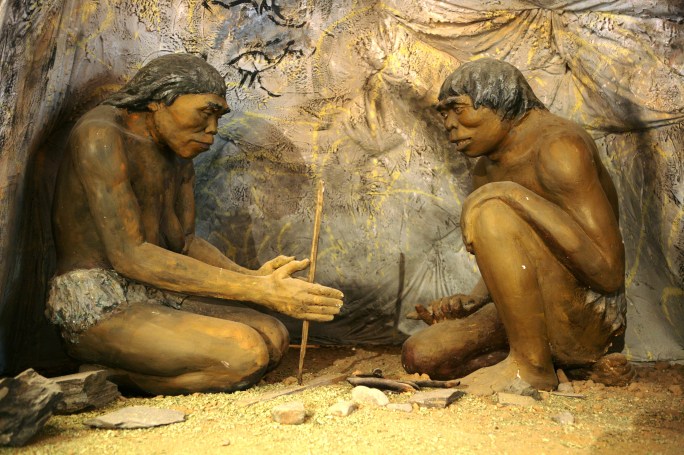
“Hm, maybe we should start building a bigger stick now…” (Image: Lance Cpl. Nathan McCord/Wiki)

But there’s another scenario. In this case the outcome of an extra-terrestrial meeting isn’t solely left to the will and whim of evolutionary forces. Instead, as has happened in our civilisation, rational choices can overcome biological impulses.

Take eating meat for example. It is generally accepted that our ancestors ate meat in their hunter-gatherer existence. But nowadays some people have come to the conclusion, to the upmost resentment of others, that killing animals and eating meat might be a tad wrong. You know, all the confinement, force-feeding, mechanised slaughter, it is a little unsettling (until you taste the bacon). Others argue the opposite, that eating meat is ‘natural’ therefore it must be the ‘right’ thing to do. This line of reasoning commits my favourite logical fallacy (don’t pretend you haven’t got one), the ad Naturam or appeal to nature logical fallacy. If we solely took our morality from nature we would live in a very cruel world indeed. (Watch a video of Mallards being natural here. Note: Morality not included; viewer discretion is advised.)

So what’s all this got to do with aliens and bacon? Well if aliens take the same stance—the choice not to kill sentient beings based on nothing else but the value that sentience confers—then perhaps we do stand a chance of a peaceful coexistence. But if aliens come with predacious intentions, aiming to harvest, experiment, extract, and/or exploit, there really is little we can do to stop them.

So hope and pray that, when our skies are darkened by the spectre of a flying saucer drifting through trembling clouds, you can smell the pungent aromas of Quorn and lentil burger emanating from the ship’s kitchen. Maybe that’s why they were called little green men all along?

R is for Ratzilla

An excerpt from my favourite scene in the 1987 film, the Princess Bride:

Westley: Rodents of Unusual Size? I don’t think they exist. [R.O.U.S. attacks Westley] Westley: Ahhhh!!!

Why is that my favourite scene?  Because I laugh every time I watch it. The R.O.U.S. is just so ridiculous-looking and shows up right after Westley disbelieves its existence.

For the devoted readers out there, you’re maybe wondering what my obsession with R.O.U.S.es is, because I’ve written about them before, but somehow they capture my imagination unlike any other strangely-proportioned creature.  I think it has something to do with the comedic effect of reversing the expectation of something cute.

Rodents of Unusual Size: They do exist. Image from the Princess Bride
Rodents of Unusual Size: They do exist. They are definitely not cute.  Image from the Princess Bride

The R.O.U.Ses from the Princess Bride have come to set the standard for overgrown rodents, but sometimes reality is stranger than fiction.

The largest discovered member of the rodent family (membership to which depends on having a pair of razor-sharp, ever-growing incisors), Josephoartigasia monesi is estimated to have been the size of a bull.

.

Reconstruction of head
A reconstruction of J. monesi’s skull based on the bones that were recovered. Image by Andres Rinderknecht & Ernesto Blanco

Since only its skull was discovered, the  weight of this creature has been debated.  The original discovery paper pegged the mass of the monstrous mulch muncher at 1211kg on average with a maximum of 2584kg. To put that into perspective, that’s anywhere from 1 to 4 dairy cows.  A more recent study, however, showed that depending on the part of the skull you use to predict the mass of the full creature, J. monesi could have weighed from as low as 356kg (half a cow) to 1534kg (back up to the 2-cow range).  Even if the creature was as small as 356kg, that still makes it nearly 6 times heavier than the current rodent heavyweight champion of the world, Floyd Mayweather the capybara.

In any case, it’s definitely big enough for a recent Science Magazine article to correctly use the term “Ratzilla”.

Rodents of Unusual Size: They do exist.  Image from the Princess Bride
RATZILLA!!!  Image by James Gurney

Ratzilla’s bite force was recently estimated up to 4000N, enough to outperform modern crocodiles and tigers.  It was definitely a herbivore though, and is thought to have used its teeth as elephants use their tusks: to dig around for tasty treats.

Luckily for us, Ratzillas (Ratzillae?) no longer roam the plains of South America.  They went extinct about 2 million years ago, after 2 million years of rodent dominance.  Interestingly, that makes them the contemporaries of terror birds, sabre-toothed cats, and giant ground sloths. Their size and sharp teeth probably made them tough prey items.

Just like the R.O.U.Ses in the Princess Bride though, they were probably susceptible to fire jets and swords.

And with this rodent rant written, I promise to not write about any more Rodents of Unusual Size for the remainder of this ABCs series.

Q is for Quokka

What’s half a metre long, weighs 3-4kg, and has the cutest face you ever did see?

Cat_Cute
Image by Gaurav Pandit

Nope, cuter.

Cute_beagle_puppy_lilly
Image by Garrett 222

Even cuter.

Quokka Cute
Image by Jin Xiang

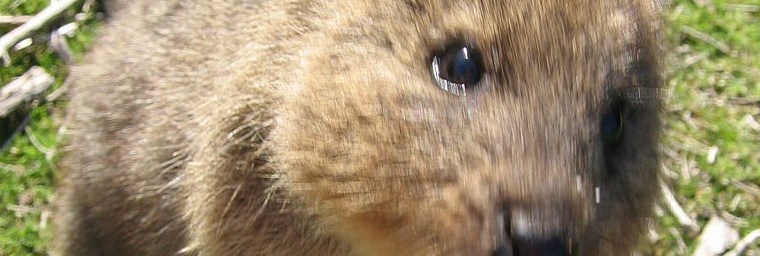
Yup, there it is!  This, dear readers, is a quokka.  A native of South west Australia, this marsupial has recently skyrocketed to fame because of the way its mouth seems to rest in an adorable little smile.  A quick Google image search will reveal hundreds of awesome pictures (that aren’t licensed under creative commons) and a growing number of quokka selfies.  It looks so happy that it has even been dubbed the mortal enemy of Grumpy Cat.

So, what’s the deal?

The quokka is a vegetarian (one of those darn salad-eaters) that prefers leaves and stems.  Since its habitat is so dry, it will swallow its food whole only to regurgitate it later, chew it up, and swallow again in order to make sure it sucks out all of the moisture.  Their digestive systems are tuned to allow survival in the dry climate of Western Australia.  This means that when humans try to feed the quokkas with bread or give them water, the poor animals can go into toxic shock and die.  For the love of all that is cute in this world, do not feed quokkas.

I'm fine with my flower.  I don't need your charity! Image by Vicsandtheworld
I’m fine with my flower. I don’t need your charity!
Image by Vicsandtheworld

Like other marsupials, quokkas have a very short pregnancy of only one month, followed by five or six months of pouch-time.  Unlike most other marsupials, quokkas have the ability to double down on their reproduction.  The day after giving birth and moving the joey to their stomach pouch, female quokkas will mate again and will pause the development of the new foetus in a process known as embryonic diapause.  If the joey in the pouch doesn’t make it (quokka-god forbid), the female can resume the embryo and still call the season a reproductive win.

One thing the quokka’s PR people (who have done an excellent job so far, by the way) might not want you to know is that female quokkas, when threatened by predators, will quite literally throw their babies under the bus.  They will eject their joey and head for the hills, hoping that the predator takes the easy prey and they get to live another day.

Image by Hesperian
A nice, happy quokka family.  That obviously didn’t resort to infanticide in the case of this joey.  Doesn’t Nature just suck sometimes?  Image by Hesperian

For the readers out there still keen to snap the perfect selfie, the best place to find quokkas is on Rottnest Island, a tiny, 19km2 bit of land off the coast of Perth.  [Non sequitur – I can’t help but hear “Purse” said with a lisp whenever I come across Perth.]  The island was named Rottnest (Rat’s Nest) by a dutch explorer who thought the resident quokkas looked like “a kind of rat as big as a common cat”.

Just like the selfie stick we know is lurking out of the frame of all those hilarious pictures, disaster may be around the corner for the quokka.  The Australian Government rates the Rottnest Island population as stable, but the quokka’s mainland habitats are under threat from foxes (an invasive species) and forest clearing.  These threatened mainland populations are especially important because they contain much more genetic diversity than the island groups.  The IUCN classifies the quokka as Vulnerable, one step above Endangered.  This is due not to the population size (upwards of 10 000), but rather to the extremely small range and susceptibility to environmental change.

The quokka's range is quite limited.
The quokka’s range is quite limited.

The quokka is a species of very cute and biologically strange marsupial whose Australian home is under a myriad of threats.  Why the internet is currently abuzz with it remains a mystery, but there are certainly some adorable pictures to be taken and some interesting things to be learned.

P is for Plant Defences

By Jonathan Farrow of the Thoughtful Pharaoh

As the great glam metal band Poison sang in 1988, “Every Rose Has Its Thorn“.

Like so many glam metal bands to grace the world’s stages before them, none of Poison’s members were botanists. If they were, they might have known that roses actually have prickles, not thorns.

It’s an easy enough mistake to make.  But because I am a pedant at heart, I want Poison to know that, technically, thorns are modified branches, spines are modified leaves, and prickles are modified skin. That means roses have prickles. I therefore petition that the lyrics of the chorus of the song be changed from:

Every rose has its thorn
Just like every night has its dawn
Just like every cowboy sings his sad, sad song
Every rose has its thorn

to the more scientifically accurate:

Every rose has its prickle
Just like brine turns veggies to pickles
Just like every cowboy is really quite fickle
Every rose has its prickle

Thorn (modified branch) from a citrus plant.
Thorn (modified branch) from a citrus plant. Image by Edgovan22
Spines (modified leaves) from a Pereskia grandifolia (aka rose cactus) plant
Spines (modified leaves) from a Pereskia grandifolia (aka rose cactus) plant  Image by Frank Vincentz
Rose_Prickles
Prickles (modified skin) from a rose bush.  Image by JJ Harrison

But how did plants come to develop all of these different ways to impale gardeners’ fingers in the first place?

To answer that question, let’s imagine a world without thorns, spines, or prickles. No toxins, sap, poisons, or deterrents of any kind.  In a world like that, as long as there were herbivores, plants wouldn’t last long.  They’d get eaten up pretty quick and getting eaten generally isn’t good for your reproductive health (with a few noticeable exceptions *cough* black widow spider *cough*).  So there’s a lot of evolutionary pressure on plants to develop ways to avoid becoming lunch.

Predation from salad-eaters isn’t the only pressure on plants, though.  They also need to compete with other plants around them by growing to capture more sunlight and they need to devote resources to reproducing.  This is called the growth-differentiation balance.  Plants, with limited resources, must choose between straightforward growth and developing specialized defences.  If this theory is true, we would expect plants that didn’t have to worry about getting eaten would be less thorny.  In October 2014, an international team of researchers showed that in an herbivore-free zone, like the favourite hangouts of leopards on an African savanna, non-thorny plants thrive, whereas the thorny plants do best in the favourite hangouts of salad-eating impalas.

Salad-eaters (aka herbivores) don’t just take an evolutionary backseat to this escalation of plant defences.  Ever since the first animals started emerging from the sea and started choosing salad, plants have been trying to send them back and animals have kept coming.  It’s an evolutionary arms race.

And if the Cold War taught us anything, its that arms races lead to some pretty ridiculous specializations.  Here are a few of my favourites on the plant side of things:

Sorcerer Corn

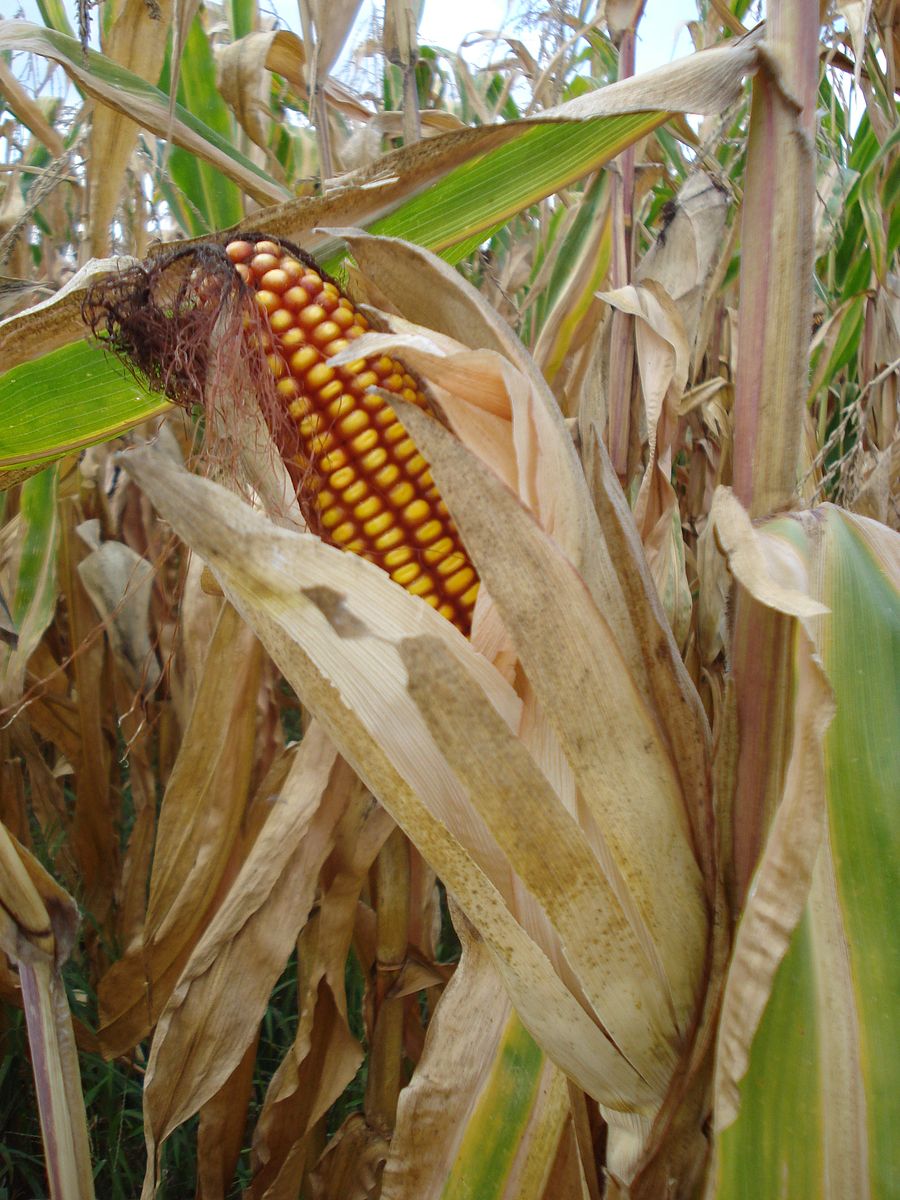
Behold! Sorcerer Corn!  Image by Silverije
Behold! Sorcerer Corn! Image by Silverije

It looks like regular corn.  And that’s because it is.

Regular corn seedlings, when exposed to a chemical in the saliva of beet armyworms, will release a chemical that summons a cloud (or, less dramatically, attracts) parasitoid wasps which will lay eggs inside of the armyworms.  These eggs will hatch after two days and eat their way through the armyworm from inside out.

Corn isn’t the only plant that releases signals like this.  In fact, you know the smell of freshly-cut grass?  That turns out to be the plant equivalent of screaming out to any relatives in the area to “GET READY! THERE’S SOMETHING THAT WILL HURT YOU NEARBY!”

Flinching Flowers

We normally think of plants as stationary things, unable to move.  This is usually true, but there are some plants which have the ability to quickly shut their flowers or droop on contact.  The most famous example of this is the Venus Flytrap, but that is more of an offensive flinch.

Image by Mnolf
Image by Mnolf

Mimosa pudica, or the sensitive plant, also has this flinching (thigmonastic) ability.  When touched, this species will close its flowers and fold away its leaves, thus decreasing its surface area and making it harder to see and eat.

I'm just going to fold away now...
I’m just going to fold away now…  Image by Hrushikesh

Whether its by developing thorns, spines, prickles, the ability to fold up, or the ability to call helpful predators, plants have not been idle in the fight against salad-eaters.  Every rose has its prickles (not thorns!) because of this ancient struggle and while they may be annoying, I guess we should be happy roses haven’t evolved to attract parasitoid bears that will leave cubs inside of our stomachs to gnaw their way out over the course of a week.

Yet.

N is for Naming

By Jonathan Farrow of the Thoughtful Pharaoh

Next time you happen to be walking though the Chamela-Cuixmala nature reserve on the West Coast of Mexico, keep your eyes out for this parasitoid wasp:

Image from a paper by Alejandro Zaldívar-Riverón, Juan José Martínez, Fadia Sara Ceccarelli, and Scott R. Shaw

Its scientific name is Heerz lukenatcha.  There is also a related wasp named Heerz tooya.  Who comes up with these things!?

Biologists, it turns out.

The current official naming system for animals is run by the International Commission on Zoological Nomenclature (ICZN).  This multi-national commission, based at the Natural History Museum in London, keeps track of all the rules as well as the accepted names.

[There are also separate codes for other types of organisms  – see this wikipedia page for a list of the codes and prepare to go down an Oryctolagus cuniculus hole]

Generally, the first person to find an organism, make sure it hasn’t been named yet, and submit a scientific paper naming it, will get to choose a name.  While there is quite a bit of freedom, the ICZN does provide the following guidance: “Authors should exercise reasonable care and consideration in forming new names to ensure that they are chosen with their subsequent users in mind and that, as far as possible, they are appropriate, compact, euphonious, memorable, and do not cause offence.”

That guidance does get stretched sometimes…

Appropriate?

During a 1980 entomological expedition to the Andes, one member of the team kept shouting “sh*t man, f*ck!” every time something went wrong.  I guess a lot of things went wrong, because before long the whole team started calling the expedition the SMF Expedition.  When a new genus of beetle was discovered, they named it Esemephe (pronounced SMF).  They justified it to the ICZN by saying that it was a melding of the greek words essymenos (hurrying) and ephestris (mantle), but everyone else knew it was really a reference to SMF.

Not so compact, euphonious, or memorable

The longest accepted scientific name is Parastratiosphecomyia stratiosphecomyioides, a species of fly.  At 42 characters, its only three short of pneumonoultramicroscopicsilicovolcanoconiosis, the longest word in the English dictionary.

Straight up offensive

Some names were actually designed to be offensive.  Two paleontologists, Cope and Marsh, basically had a naming war at the end of the 19th century. Marsh seemingly struck the first blow, submitting Mosasaurus copeanus (-anus is a greek suffix meaning ringed).  Later, Cope named an extinct mammal Anisonchus cophater for all of his haters.  I guess he just wanted to shake it off.

This trend was repeated in the 20’s with swedes Elsa Warburg and Orvar Isberg. In 1925, Warburg named a trilobite Isbergia planifrons, after Isberg’s apparently flat forehead (an insult in Scandanavia).  In 1934, Isberg retaliated with a mussel he named Warburgia crassa, after Warburg’s girth (crassa=fat).

Just funny

Sometimes, biologists just feel silly.  Here are a few of my favourite scientific names, as a reminder that scientists can be funny.

There is a genus of fungus beetles called Gelae.  The species names are baen, belae, donut, fish, and rol.  Put those together and you get a whole bunch of tasty treats!  There is another genus of beetle called Agra, and one biologist in particular, Terry Erwin, has had a lot of fun over the years with some punny species names like cadabra, memnon, and vation.

Sometimes biologists go for the celebrity names, like a beetle named Scaptia beyonceae for the yellow fur on its behind or a fossil fly named Carmenelectra shechisme (pronounced Carmen Electra, She Kiss Me).  In 2013, Carmenelectra shehuggme was also added.

Other times, taxonomists like to make you read it a few times, like a moth named Eubetia bigaulae or a scarab in a large family named Cyclocephala nodanotherwon.

For hundreds of more interesting biological names, visit curioustaxonomy.net

L is for Loch Ness

By Jonathan Farrow from The Thoughtful Pharaoh

Loch Ness, in the middle of the Scottish Highlands, has more fresh water in it than all the lakes and rivers in England and Wales combined.  It is neither the deepest lake in Britain nor the largest by surface area, but since it comes a close second in both categories, it claims the top spot for volume.  The loch is home to eels, salmon, and char and its shores support a healthy population of deer and waterfowl.  The area has historical significance as well, with Urquhart castle being instrumental in the war of Scottish independence.

Loch Ness, in all of its Google Map glory.  Not pictured: the monster.
Loch Ness, in all of its Google Map glory. Not pictured: the monster.

Despite all of this, when people read or hear “Loch Ness”, the next word they think of is almost always “monster”.  This is a shame, because sadly, Nessie does not exist.

We know this for sure.  There have been numerous, comprehensive reviews of the ‘evidence’ and a recent sonar survey of the entire loch failed to turn up anything even close to a giant sea monster.  If Nessie is supposed to be a plesiosaur, you might think a population of giant, carnivorous sea creatures that somehow survived extinction and has been living in the same lake for 65 million years would make more of an impact on people in the region.  There would be lots of stories about sea monsters, and old ones too.  There aren’t really any credible mentions of this monster until the 1930s.  No songs, folk tales, or myths, despite the area being populated for thousands of years.

Not a sea monster, 1934.  Photo by Robert Wilson, published in the Daily Mail
Not a sea monster, 1934. Photo by Robert Wilson, published in the Daily Mail
Also not a sea monster, 1977.  Photo by Anthony Shiels
Also not a sea monster, 1977. Photo by Anthony Shiels
Still not a sea monster, 2012.  Photo by George Edwards
Still not a sea monster, 2012. Photo by George Edwards

My favourite little tidbit from my reading into the series of Nessie hoax photographs is a photo of a supposed flipper which was used to name a new species in Nature in 1975.  The scientific name of the Loch Ness Monster, according to Profs. Peter Scott and Robert Rines, is Nessiteras rhombopteryx.  I leave it up to the reader to decide if it is a coincidence that the name is an anagram for “monster hoax by Sir Peter S”.

The 1972 'flippers' in question.  Hard to see much at all, I think. Photo by Academy of Applied Science/Loch Ness Investigation Bureau
The 1972 ‘flippers’ in question. Hard to see much at all, I think. Photo by Academy of Applied Science/Loch Ness Investigation Bureau

While it is undoubtedly good fun to trash pseudoscience, the focus on the monsters of Loch Ness (or lack thereof) takes attention away from what I think is much more interesting: Loch Ness is part of the very same geological feature as the fjords in Norway, the hills in Newfoundland, the Gulf of St. Lawrence, and the Appalachian mountains in the southern USA.

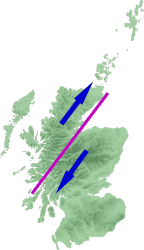
Loch Ness is part of the Great Glen Fault, a crack in the Earth’s crust that runs in a straight line across Scotland, through the Irish Sea, and into Northern Ireland.  This crack is very old, pre-dating even Pangea.

When two pieces of the Earth's crust slide against each other like this, it is called a transcurrent, or strike-slip, fault.  Image by Hellinterface
When two pieces of the Earth’s crust slide against each other like this, it is called a transcurrent, or strike-slip, fault. Image by Hellinterface

In fact, the process that brought the continents together into the supercontinent of Pangea is the very same one that created mountains along this fault line.  Back in those days, over 400 million years ago, the Atlantic ocean didn’t exist.  As the plates of Baltica (modern-day Scandinavia and North-Eastern Europe) collided with Laurentia (modern-day North America and Greenland) and the small microcontinent of Avalonia (modern-day England, Wales, and parts of Northern France), bits of the crust were pushed up.  This formed mountains.

As the plates collided, the highlighted area became raised.  The grey lines in this image are the current coastlines.  Image by Woudloper.
As the plates collided, the highlighted area became raised. The grey lines in this image are the current coastlines. Image by Woudloper.

Over time, the plates continued to move, and the Mid-Atlantic Ridge pushed Europe and North America apart, forming the Atlantic Ocean.  While Laurentia and Baltica are still around as the bases of the North American and Eurasian Plates, Avalonia was essentially spread to the winds.

Avalonia definitely got the roughest deal out of the three colliding plates. Image by Woudloper
Avalonia definitely got the roughest deal out of the three colliding plates.
Image by Woudloper

This is why, if you walk the Highlands of Scotland or the Appalachians, you will find the same rock types.  They were born in the same place in the same way, and have become separated by an ocean.

Loch Ness is an incredibly poignant way to visualize this separation because, just by looking at a map, you can see a crack in the earth.  If you look at the Northeastern part of Newfoundland, you can see the same crack with the same angle.

[For another explanation of this 400 million year old connection, watch this video by Tom Scott.]

Loch Ness is a wonderful place, not only for its natural beauty, but also for its geology.  So do go visit, but don’t expect to find a monster.

K is for Kepler

“Truth is the daughter of time, and I feel no shame in being her midwife.” Johannes Kepler

These words, written by Johannes Kepler in 1611, are profound.  At the time, Galileo had just discovered the Galilean moons (including Europa) in Florence but was being persecuted for his belief that the Earth orbits the sun.  Kepler, a staunch supporter of heliocentrism, was working as the Imperial Mathematician in Prague.  When word that Galileo had used a telescope to find the moons reached Kepler, he was so fascinated and impressed that he wrote an enthusiastic letter of support and scrawled that pithy aphorism.

While Kepler enjoyed some social status as Imperial Mathematician and was much more free to contradict Aristotle than his Italian counterparts, his life was by no means a charmed one.  The son of “an immoral, rough and quarrelsome soldier” (his own words), Kepler managed to carve himself a place in history based on his skill as a mathematician and astronomer.  He kept on working through many family disasters, including the deaths of his wife and his seven year old son and a witch trial about his mother.

Kepler was a devout Christian and grew up Lutheran but was excommunicated due to his rejection of the Augsburg Confession.  This left him neither a Lutheran nor a Catholic and between sides when the Thirty Years War broke out in 1618.

You've got to love that frilly collar.  Just like Shakespeare!  Actually, come to think of it, Kepler actually lived at the exact same time as Shakespeare.  I wonder if they ever met and what they might say to each other at a dinner party.  Image is public domain.
You’ve got to love that frilly collar. Just like Shakespeare! Actually, come to think of it, Kepler lived at the same time as Shakespeare. I wonder if they ever met and what they might say to each other at a dinner party. Image is public domain.

Despite all of this, Kepler revolutionized astronomy by formulating mathematical laws that accurately describe the motions of the planets.  These are still taught in astronomy today and are called Kepler’s Laws.

The first law is that planets orbit in ellipses with the sun at one focus.  Before Kepler, most Western astronomers modelled the orbits of planets as circles and had to invoke a strange concepts like epicycles and equant points.

1. Planets orbit in ellipses, not circles.
1. Planets orbit in ellipses, not circles.  Image my own

The second law is that a line between a planet and a star will sweep out equal area in equal time. In other words, planets move faster when they are closer to their star and slower when they are further away.  This law is better understood with a diagram:

asd
2. Planets don’t have constant speed  Image by RJHall

The third law, formulated after the first two, is that the time it takes a planet to make an orbit (orbital period) is directly proportional to its distance from the star.  This law allows astronomers to calculate how far a planet is from its star based only on information about the length of its year and the mass of the star.  Remember this one, because it will become important later.

As you can see, Kepler’s Laws are fundamental to our understanding of how planets move, or orbital dynamics.  It will come as no surprise then that every young astronomer is all too familiar with Kepler’s laws.  This isn’t the only reason he’s familiar though.  He is also shares a name with the most successful exoplanet hunter the world has ever produced.  The Kepler Space Telescope.

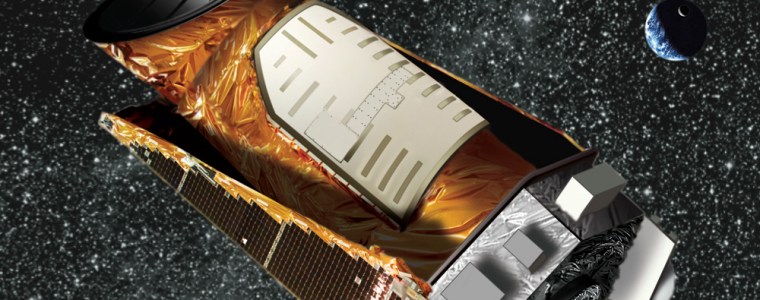
Kepler: Planet Hunter is kind of Like Abraham Lincoln: Vampire Hunter.  Except more real.  And frankly, a little more impressive.    Image by Wendy Stenzel at NASA
Kepler: Planet Hunter is kind of like Abraham Lincoln: Vampire Hunter. Except more real. And frankly, a little more impressive. Image by Wendy Stenzel at NASA

Launched in 2009, the Kepler Space Telescope used 42 image sensors to continuously observe over 145,000 stars.  Unlike a lot of other telescopes that try to take magnified images, Kepler wasn’t interested in images.  It wanted accurate data on brightness.  It basically had a staring contest with these 145,000+ stars, waiting for them to blink.  I say blink because Kepler was waiting for the brightness to go down and back up.  The brightness of stars can vary for all sorts of reasons, but planets passing in front of their stars make the brightness dip in a particular way.  This dip is called a transit and finding transits was Kepler’s mission.

When a transit occurs, the size of the brightness dip corresponds to the size of the planet and the length of the dip corresponds to the time it takes a planet to orbit (as well as the size of the star).  Remembering Kepler’s third law,  if we know the time it takes to orbit, we can figure out the distance to the star.  And if we know the brightness of a star and the distance, we can figure out how much energy the planet receives.  Plug all that in to a simple(ish) equation, and out pops temperature.

Stars, just like planets and people, come in all different shapes and sizes.  That means light curves also vary widely.   Image from Planethunters.org
Stars, just like planets and people, come in all different shapes and sizes. That means light curves also vary widely. Image from Planethunters.org, a great citizen science project that combines people’s natural pattern-finding ability with Kepler data to find planets.

So thanks to the Keplers (both Johannes and the Space Telescope) we can start to look for alien worlds that have temperatures similar to the ones we find here.  The hope is that one day we will find evidence of life on another planet.  And then we can begin our transition into any one of several sci-fi galactic civilizations (my personal favourite is Foundation, but some people prefer Star Wars, Star Trek, or Eve Online).

Unfortunately, in May 2013 one of the components that kept Kepler (the telescope) stable failed, meaning the mission was apparently over.  The mission had been hugely successful, discovering over 1000 confirmed planets, with 4000 other planet candidates waiting to be confirmed.  It turns out that most stars probably have planets and that a lot of planets in the galaxy might be the right temperature to be habitable.

Astronomers are nothing if not persistent though, so an ingenious method was devised to make sure Kepler can continue observing even without its stabilizer.  This new mission, dubbed K2, uses the radiation pressure from the sun itself to balance the telescope.  Instead of continuously observing the same 145 000 stars, K2s targets will change periodically as it orbits the sun.  There will be far less data coming down, but as of this writing four new planets have already been found since K2 began in earnest in June 2014.

There's a lot of information there, but I think the most impressive bit is that K2 is metaphorically balancing a pencil on a fingertip, remotely, from 150 million km away.  Image by NASA
There’s a lot of information there, but I think the most impressive bit is that K2 is metaphorically balancing a pencil on a fingertip, remotely, from 150 million km away. Image by NASA

Currently, while there are all sorts of really interesting exoplanets out there (from hot jupiters like 51 peg b to mirror earths like Kepler-438b), we have yet to find signs of life.  But I think that before too long, we will.  Just as the truth of heliocentrism eventually came out thanks to Kepler, a telescope with his name will be instrumental in uncovering the truth of life elsewhere in the universe.  Just like he said,

“Truth is the daughter of time, and I feel no shame in being her midwife” Johannes Kepler

I is for Island Evolution

By Jonathan Farrow from The Thoughtful Pharaoh

Unbeknownst to the rest of us, a debate has been raging in the world of biogeography.  The debate stems from a simple observation made by a young Canadian scientist in 1964: island animals are weird.  Sometimes they’re way bigger than normal, like the Tenerife Giant Rat, and other times they are way smaller than normal, like the Elephas falconeri, a tiny species of elephant.

A Rodent of Unusual Size, the (now extinct) Tenerife Giant Rat.  Image by Wikimedia user M0rph
A Rodent Of Unusual Size, the (now extinct) Tenerife Giant Rat. It reached sizes of up to 1.14m  Image by Wikimedia user M0rph
Elephas_skeleton
An itty-bitty extinct elephant thought to have weighed only 200kg. Image by Ninjatacoshell at the North American Musueum of Ancient Life

J.B. Foster published a short, two-page paper in the April 1964 edition of Nature positing that rodents get bigger and lapidomorphs (rabbits), carnivores, and artiodactyls (deer/goats) get smaller on islands.  This, he thought, was because small animals found the isolation of islands to be liberating.  They no longer had to worry about predators and could grow to fill their new space.  Larger animals, however, might be restricted by the relative paucity of resources on islands and would have immense evolutionary pressure to become smaller.

This led to Foster’s Rule, also known as the Island Rule.  It states that in general, big animals get small on islands and small animals get big.  They also do so very quickly (in evolutionary terms).  For instance, red deer on Jersey, an island in the English Channel, were shown to have shrunk to to 1/6th their original size in only 6000 years.

There’s a problem, though.  Like pretty much every rule in biology, there are lots of exceptions.  Sometimes small animals get smaller (like Brookesia micra, the world’s tiniest chameleon) and relatively big animals get bigger (like Haast’s eagles).

So cute, right!?  Image by Frank Glaw, Jörn Köhler, Ted M. Townsend, Miguel Vences
You’ve heard of angels on the head of pin, but what about chameleons on the head of a match. So cute, right!? Image by Frank Glaw, Jörn Köhler, Ted M. Townsend, Miguel Vences
The giant, moa-hunting Haast's Eagle of New Zealand.  Almost as scary as terror birds.
The giant, moa-hunting Haast’s Eagle of New Zealand. Almost as scary as terror birds.  Image by John Megahan

A 2011 article by a joint Israeli-Italian-British team of researchers calls the whole theory into question, showing that the smallest species in any given group is no more likely to be from an island than would be expected by chance. Size extremes, they say, exist everywhere.  Islands don’t have some sort of monopoly.  They do concede that large mammals tend to get smaller, but they think the idea that small animals get bigger only seems like common sense because they are easier to notice.

A British paper from 2008 throws even more confusion into the mix, showing that depending on the kinds of statistical tests you use, you can show that the island rule either exists or doesn’t.  They suggest that the island rule should be looked at in “taxonomically restricted studies” – biologist-speak for “case-by-case basis”.  That seems to kind of defeat the purpose of a nice heuristic, though.

One thing we know for sure is that islands isolate organisms.  This isolation means that evolution can work differently for the island population and might lead to all sorts of interesting changes.  This type of evolutionary change is also called allopatric speciation and is responsible for the variation that Darwin saw in Galapagos finches.  Whether islands always create a particular kind of change is still up for discussion, but nobody can doubt that when organisms of unusual size appear, they deserve attention.

Darwin's famous finches.  He observed that some beaks were better suited for cracking seeds and others for tearing fruit.
Darwin’s famous finches.  Image from The Voyage of the Beagle

E is for Europa

By Jonathan Farrow from the Thoughtful Pharaoh

Galileo Galilei is quite a famous astronomer but many of the discoveries he’s known for are just extensions of the work of others.  For instance, he didn’t come up with the idea that the Sun is the centre of the Solar System, he just got in big trouble for it.  He also didn’t invent the telescope (even though he is often credited).  He was just one of the first people to point it up at night to look at stars instead of over the sea at enemy ships.  One thing he did do, all by himself, was observe that Jupiter had some friends that followed it around the sky.

If you're interested in the story of Galileo Galilei, I'd recommend checking out a Bertolt Brecht play called A Life of Galileo.
Definitely a direct quote from his notes: “Hey, Jupiter! Jupiter!  Don’t turn around…. but I think those moons are following you…”    [If you’re interested in the story of Galileo Galilei, I’d recommend checking out a Bertolt Brecht play called A Life of Galileo.  If you’re not interested, I’d recommend reading this book instead.]      Image is a 16th century painting by Justus Sustermans
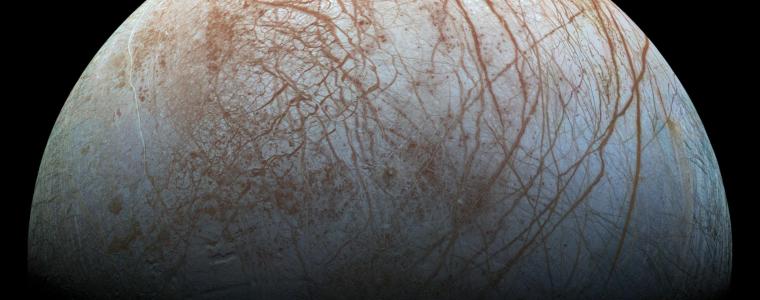
In about 1610, Galileo discovered the four largest moons of Jupiter: Io, Europa, Callisto, and Ganymede.  While these celestial objects are all interesting in their own right, today I’m going to focus on Europa because it is one of the most credible candidates for extraterrestrial life.

Why might this be, and where the heck is Europa anyways?  I’ll let my friends (I use the term loosely) at the NASA Jet Propulsion Laboratory explain:

Europa FINAL_9_30_br
Thanks, NASA!

While the logic there might be a bit suspect (Earth and Europa are very different systems and the rules for one don’t necessarily apply for the other), I think the infographic gives a pretty nice introduction to Europa and helps to underline that for astrobiologists, the search for life in the Universe is almost synonymous with the search for water.

And Europa certainly has a lot of water.  Unfortunately, the H2O is mostly trapped under kilometres-thick sheets of ice.  This has posed a serious problem for scientists because in order to sample to subsurface ocean and find out if there is indeed life on that cold, watery world, a mission would need to drill through an unknown distance of ice (but certainly on the order of kilometres) and maintain contact with Earth.  Even with all of the resources available to us here on Earth, the deepest we’ve been able to go is about 12km.  The technical challenges of remotely drilling through such a thick ice sheet have kept many Europa mission concepts off the table.

A recent discovery, however, has made a productive mission to Europa much more feasible.  It turns out that Europa sporadically ejects plumes of water vapour.  Unlike its cousins Io (another moon of Jupiter) and Enceladus (a moon of Saturn), Europa’s plumes are much less frequent, smaller, and harder to predict.  We know that the polar regions have the weakest ice but for some reason plumes just don’t occur very often.  They are also hard to catch on film because Europa’s relatively strong gravity means the water can’t go very high and it comes back down pretty quickly.  It took the Hubble Space telescope a few tries before it finally caught the sneaky tooter in action in 2013. It’s kind of like Old Faithful, but much older and less faithful.  So more like Ancient Temperamental.

What one of these Ancient Temperamental's might look like.  An artist's conception  NASA/ESA/K. Retherford/SWRI
What one of these Ancient Temperamental’s might look like. An artist’s conception NASA/ESA/K. Retherford/SWRI

While nowhere near the scale of the plumes of Enceladus, Europa’s plumes are still upwards of 200 km high.  This means that in order to sample its water, all we need to do is fly through and sniff.  That’s what Europa Clipper, a current mission concept, aims to do.  For anybody wondering, there are also plenty of people who want to fly through the plumes of Enceladus as well.

Buzz about Europa has definitely grown a lot since it was just a dot in the telescope that Galileo pointed up (but didn’t invent).  Actually, last week the White House announced $30 million in funding for developing a mission to Europa and next week NASA is hosting a workshop about Europa’s plumes.

D is for Dinosaur Evolution

By Jonathan Farrow from The Thoughtful Pharaoh

When was the last time you ate dinosaur?  I had some just the other day, next to my peas and carrots.

File:Washing peas and carrots.jpg

Shocking as it may seem, dinosaurs are all around us and we interact with them on a fairly regular basis.  If you’re sitting there saying to yourself, “No, dinosaurs went extinct millions of years ago!”, let me remind you of one critical and oft-forgotten fact: all modern birds (including chickens, turkeys, toucans, and cuckoos) are dinosaurs.  That’s right, the mascot for Froot Loops is a dinosaur.  KFC can change it’s name to Kentucky Fried Dinosaur and still be scientifically accurate.

How can this be?   It all has to do with how biologists name and classify organisms (the technical term for this is taxonomy).  Scientists, being very much into order and rationality, made up a few systems for naming organisms and describing their evolutionary relationships.  The system I’m going to focus on today, cladistics, has only a few basic rules and is incredibly helpful for understanding the history of life on our planet.  Unfortunately it can be a bit daunting because there is some pretty scary-looking jargon.  Let’s unpack some of that jargon and apply it to dinosaurs in order to find out how the heck the same word can be used to (correctly) describe animals as different as stegosauruses and canaries.

File:Stegosaurus Struct.jpg
Dinosaur, Photo by Yosemite
File:Serinus canaria -Parque Rural del Nublo, Gran Canaria, Spain -male-8a.jpg
Also a dinosaur, Photo by Juan Emilio

Two of the most important concepts for cladistics are that:

  1. All life on Earth evolved from a single common ancestor.
  2. Organisms should be classified based on last common ancestors, with organisms that share recent common ancestors being interpreted to be more closely related than organisms with more distant common ancestors.

Think of your family.  Everyone is descended from your grandparents (premise #1 above) and you are more closely related to your siblings (last common ancestor is your parents) than your cousins (last common ancestor is your grandparents; premise #2 above).

Screen Shot 2015-01-22 at 7.12.48 PM

Those are the basic rules of cladistics.  Pretty simple in theory, right?  The problem is that with organisms that have been dead for millions of years and only leave behind fragments of bone, deciding where they fit in to the family tree gets difficult.

File:House of ROMANOV-tree-fr.png
Like fitting Rasputin into this Romanov family tree.

Now let’s look at some of that jargon I promised.

The first word we need to understand is monophyletic.  A monophyletic group is a set of organisms that all share a common ancestor.  You, your siblings, and your mum make a monophyletic group.  You, your siblings, your mum, and your dad are not monophyletic because (hopefully) your mom and dad are not related.  Some scientists call monophyletic groups clades and they are the bedrock of cladistics.  A “proper” group must be monophyletic.

Screen Shot 2015-01-22 at 7.15.04 PM
A nice pink monophyletic group with you right in the middle.  Examples from nature include birds and primates.

If the group you’re looking at isn’t monophyletic, it might be paraphyletic or polyphyletic.  These are two types of almost-groups that can confuse a lot of people.  Paraphyletic groups choose a section of the family tree, ignoring a large chunk.  Polyphyletic groups choose a few individuals throughout the tree without regard for common ancestors.  In the family analogy, a paraphyletic group could include your mom and two of your siblings but not you.  A polyphyletic group might include you and your cousin.

A nice purple monophyletic group.  Some examples from nature: bacteria and birds.
A less-nice purple paraphyletic group. Some examples from nature: Reptiles, Fish
Screen Shot 2015-01-22 at 7.18.34 PM
A rather arbitrary blue polyphyletic group.  Examples from nature: flightless birds, warm-blooded animals.

Phylogenetic trees are the most common tool used by biologists to depict evolutionary relationships.  Generally the root of the tree is interpreted to be the oldest and the branches are the newest.  Every branching point is called a node.

So far we’ve been looking at phylogenetic trees of your hypothetical family, but now that we have a primer in cladistics under our belts, we can start to look at a dinosaur phylogenetic tree.

Image from an article by Matt Wendel at UC Berkeley

The way to interpret this diagram is to think of time increasing as you read up. At the bottom there are the most recent common ancestor of all crocodiles, pterosaurs, and dinosaurs: Archosaurs.  Just as with all of the other terms on this diagram, everything up from any given node belongs to the group labelled at the node.  This means that all dinosaurs are archosaurs (but not all archosaurs are dinosaurs).

Archosaurs evolved in the late Permian or early Triassic period, about 250 million years ago.  The most familiar archosaurs from that time are probably sail-backed beasts like Ctenosauriscus koeneni.

File:Ctenosauriscus BW.jpg
Image by Nobu Tamara

At the next node, you see ornithodirans, a word which refers to dinosaurs and pterosaurs. The interesting part to note here is that pterosaurs (like pterodactyls and Quetzalcoatlus) aren’t dinosaurs.  They are the closest relatives to dinosaurs without actually being dinosaurs.

Those are some big flying non-dinosaurs!

The next node on that diagram is the one we’ve been waiting for: Dinosaurs! As you can see, dinosaurs are a monophyletic group.  If you want to refer to the dinosaurs that were wiped out by an asteroid 65 million years ago, you have to make a paraphyletic group and exclude birds.  You can do this by saying “non-avian dinosaurs”.  Let the pedantry begin!

A picture I took at the Oxford Museum of Natural History.  Can you spot what's wrong with this panel?  High horses feel nice, don't they?
A picture I took at the Oxford Museum of Natural History. Can you spot what’s wrong with this panel? High horses feel nice, don’t they?

As the diagram shows, the dinosaur lineage splits at this point and we find one of the most important features that helps scientists classify dinosaurs.  It all comes down to the hip.  One group, the ornithischians, have backwards-facing pubises in line with their ischia, while saurischians have down-and-forwards facing pubises at an angle to their ischia.  This will become much clearer with some labelled images:

ornithischpelvis saurpelvis

Once you know to look for it, this difference becomes glaringly obvious whenever you look at a dinosaur skeleton.  Here, have a look at a few different images of dinosaurs and see if you can tell if its ornithischian or saurischian (I often just think of these as O– and S– because even when I say them in my head I trip over the -ischi-).

Tyrannosaurus_skeletonStego-marsh-1896-US_geological_surveyBrontosaurus_skeleton_1880s

You are well on your way to being a dinosaur expert!

The last node we are going to discuss in the evolution of dinosaurs is the theropods.  The word itself means beast feet and it is the last taxonomic word you can use to accurately describe both T-Rex and turkey.  Theropods are a terrifying group of creatures, laying claim to speedy velociraptors, vicious ceratosaurs, and of course, the King, Tyrannosaurus Rex.  They evolved fairly early on (~230 million years ago) and include most carnivorous dinosaurs and their descendants.

My favourite extinct dinosaur is Ankylosaurus magniventris, an armoured tank of a creature with a club-tail that definitely meant business.  On the other hand, my favourite non-extinct dinosaur is probably Meleagris gallopavoa colourful but mean-looking dino best served with potatoes and cranberry sauce.