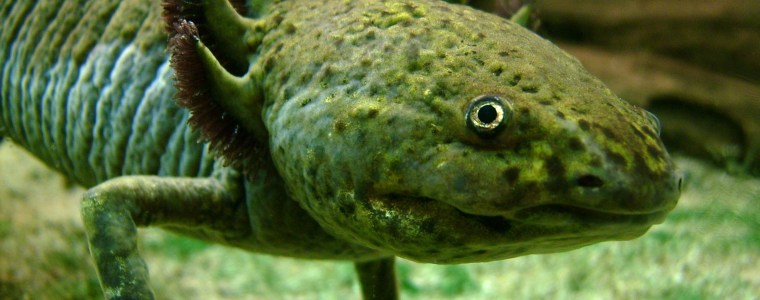
D is for Dinosaur Evolution

By Jonathan Farrow from The Thoughtful Pharaoh

When was the last time you ate dinosaur?  I had some just the other day, next to my peas and carrots.

File:Washing peas and carrots.jpg

Shocking as it may seem, dinosaurs are all around us and we interact with them on a fairly regular basis.  If you’re sitting there saying to yourself, “No, dinosaurs went extinct millions of years ago!”, let me remind you of one critical and oft-forgotten fact: all modern birds (including chickens, turkeys, toucans, and cuckoos) are dinosaurs.  That’s right, the mascot for Froot Loops is a dinosaur.  KFC can change it’s name to Kentucky Fried Dinosaur and still be scientifically accurate.

How can this be?   It all has to do with how biologists name and classify organisms (the technical term for this is taxonomy).  Scientists, being very much into order and rationality, made up a few systems for naming organisms and describing their evolutionary relationships.  The system I’m going to focus on today, cladistics, has only a few basic rules and is incredibly helpful for understanding the history of life on our planet.  Unfortunately it can be a bit daunting because there is some pretty scary-looking jargon.  Let’s unpack some of that jargon and apply it to dinosaurs in order to find out how the heck the same word can be used to (correctly) describe animals as different as stegosauruses and canaries.

File:Stegosaurus Struct.jpg
Dinosaur, Photo by Yosemite
File:Serinus canaria -Parque Rural del Nublo, Gran Canaria, Spain -male-8a.jpg
Also a dinosaur, Photo by Juan Emilio

Two of the most important concepts for cladistics are that:

  1. All life on Earth evolved from a single common ancestor.
  2. Organisms should be classified based on last common ancestors, with organisms that share recent common ancestors being interpreted to be more closely related than organisms with more distant common ancestors.

Think of your family.  Everyone is descended from your grandparents (premise #1 above) and you are more closely related to your siblings (last common ancestor is your parents) than your cousins (last common ancestor is your grandparents; premise #2 above).

Screen Shot 2015-01-22 at 7.12.48 PM

Those are the basic rules of cladistics.  Pretty simple in theory, right?  The problem is that with organisms that have been dead for millions of years and only leave behind fragments of bone, deciding where they fit in to the family tree gets difficult.

File:House of ROMANOV-tree-fr.png
Like fitting Rasputin into this Romanov family tree.

Now let’s look at some of that jargon I promised.

The first word we need to understand is monophyletic.  A monophyletic group is a set of organisms that all share a common ancestor.  You, your siblings, and your mum make a monophyletic group.  You, your siblings, your mum, and your dad are not monophyletic because (hopefully) your mom and dad are not related.  Some scientists call monophyletic groups clades and they are the bedrock of cladistics.  A “proper” group must be monophyletic.

Screen Shot 2015-01-22 at 7.15.04 PM
A nice pink monophyletic group with you right in the middle.  Examples from nature include birds and primates.

If the group you’re looking at isn’t monophyletic, it might be paraphyletic or polyphyletic.  These are two types of almost-groups that can confuse a lot of people.  Paraphyletic groups choose a section of the family tree, ignoring a large chunk.  Polyphyletic groups choose a few individuals throughout the tree without regard for common ancestors.  In the family analogy, a paraphyletic group could include your mom and two of your siblings but not you.  A polyphyletic group might include you and your cousin.

A nice purple monophyletic group.  Some examples from nature: bacteria and birds.
A less-nice purple paraphyletic group. Some examples from nature: Reptiles, Fish
Screen Shot 2015-01-22 at 7.18.34 PM
A rather arbitrary blue polyphyletic group.  Examples from nature: flightless birds, warm-blooded animals.

Phylogenetic trees are the most common tool used by biologists to depict evolutionary relationships.  Generally the root of the tree is interpreted to be the oldest and the branches are the newest.  Every branching point is called a node.

So far we’ve been looking at phylogenetic trees of your hypothetical family, but now that we have a primer in cladistics under our belts, we can start to look at a dinosaur phylogenetic tree.

Image from an article by Matt Wendel at UC Berkeley

The way to interpret this diagram is to think of time increasing as you read up. At the bottom there are the most recent common ancestor of all crocodiles, pterosaurs, and dinosaurs: Archosaurs.  Just as with all of the other terms on this diagram, everything up from any given node belongs to the group labelled at the node.  This means that all dinosaurs are archosaurs (but not all archosaurs are dinosaurs).

Archosaurs evolved in the late Permian or early Triassic period, about 250 million years ago.  The most familiar archosaurs from that time are probably sail-backed beasts like Ctenosauriscus koeneni.

File:Ctenosauriscus BW.jpg
Image by Nobu Tamara

At the next node, you see ornithodirans, a word which refers to dinosaurs and pterosaurs. The interesting part to note here is that pterosaurs (like pterodactyls and Quetzalcoatlus) aren’t dinosaurs.  They are the closest relatives to dinosaurs without actually being dinosaurs.

Those are some big flying non-dinosaurs!

The next node on that diagram is the one we’ve been waiting for: Dinosaurs! As you can see, dinosaurs are a monophyletic group.  If you want to refer to the dinosaurs that were wiped out by an asteroid 65 million years ago, you have to make a paraphyletic group and exclude birds.  You can do this by saying “non-avian dinosaurs”.  Let the pedantry begin!

A picture I took at the Oxford Museum of Natural History.  Can you spot what's wrong with this panel?  High horses feel nice, don't they?
A picture I took at the Oxford Museum of Natural History. Can you spot what’s wrong with this panel? High horses feel nice, don’t they?

As the diagram shows, the dinosaur lineage splits at this point and we find one of the most important features that helps scientists classify dinosaurs.  It all comes down to the hip.  One group, the ornithischians, have backwards-facing pubises in line with their ischia, while saurischians have down-and-forwards facing pubises at an angle to their ischia.  This will become much clearer with some labelled images:

ornithischpelvis saurpelvis

Once you know to look for it, this difference becomes glaringly obvious whenever you look at a dinosaur skeleton.  Here, have a look at a few different images of dinosaurs and see if you can tell if its ornithischian or saurischian (I often just think of these as O– and S– because even when I say them in my head I trip over the -ischi-).

Tyrannosaurus_skeletonStego-marsh-1896-US_geological_surveyBrontosaurus_skeleton_1880s

You are well on your way to being a dinosaur expert!

The last node we are going to discuss in the evolution of dinosaurs is the theropods.  The word itself means beast feet and it is the last taxonomic word you can use to accurately describe both T-Rex and turkey.  Theropods are a terrifying group of creatures, laying claim to speedy velociraptors, vicious ceratosaurs, and of course, the King, Tyrannosaurus Rex.  They evolved fairly early on (~230 million years ago) and include most carnivorous dinosaurs and their descendants.

My favourite extinct dinosaur is Ankylosaurus magniventris, an armoured tank of a creature with a club-tail that definitely meant business.  On the other hand, my favourite non-extinct dinosaur is probably Meleagris gallopavoa colourful but mean-looking dino best served with potatoes and cranberry sauce.
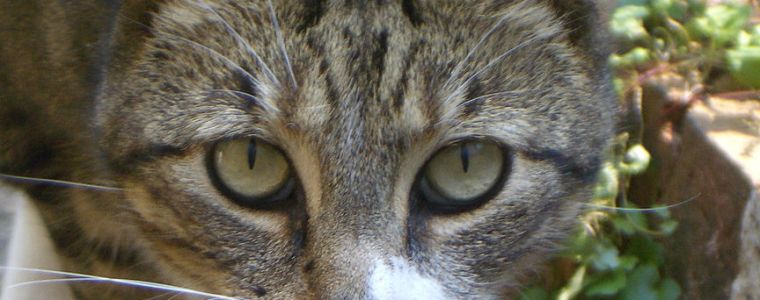
C is for Cat Feces

By Jonathan Farrow from The Thoughtful Pharaoh

I’ve never been a cat person, myself.  They just seem a bit too contemptuous as a species.

Cats, aside from being aloof, clawed, and kind of mean, also form a necessary part in the life cycle of a single-celled protozoan called Toxoplasma gondii.  This sneaky parasite can only reproduce in feline intestines but also finds its way into the tissues of pretty much all warm-blooded mammals.  Its reach seems almost limitless and extends to more than half of the world’s bears, birds, cattle, cats, domestic chickens, deer, dogs, domestic geese, goats, mice, pigs, rabbits, rats, sea otters, sheep, and humans.  And those are only the populations that were studied.  Ever heard the expression that glitter is the herpes of the craft world because it gets everywhere?  More accurately, glitter is the T. gondii of the craft world.

The life cycle of Toxoplasma gondii.  Humans are on the left side of this diagram along with the rodents and small birds.  Image from
The life cycle of Toxoplasma gondii. Humans, along with the rest of Noah’s menagerie, would be on the left side of this diagram. Felines, aka devilspawn, are on the right.  Image from Wikipedia

I call it sneaky because T. gondii has been shown to alter the behaviour of its rodent hosts in order to make it more likely to be ingested.  The physical mechanism for this is still under investigation and largely unknown but there are two interesting experiments worth noting.  The first found that rodents infected with T. gondii are more active and more excited about new places, making them more likely to be noticed (and eaten) by cats.  The second purports that rodent brain chemistry is altered so that the unfortunate rats finds the scent of cat pee sexually attractive.  The scientific paper which explains this second theory is even titled “Fatal attraction in rats infected with Toxoplasma gondii”.

A lesson for rodents:  don't listen to the parasite in your brain.  Cat pee IS NOT ATTRACTIVE! Image from Wikimedia
A lesson for rodents: don’t listen to the parasite in your brain. Cat pee IS NOT ATTRACTIVE!
Image from Wikimedia user Lxowle

So we’re pretty confident that T. gondii can alter the behaviour of rodents, but what does it do to humans?

We’re not sure…

For those with weak immune systems or for the pregnant, a T. gondii infection can cause acute toxoplasmosis, a potentially fatal disease characterised by swelling lymph nodes, sore muscles, and flu-like symptoms.  I wouldn’t worry about that too much because it’s about as lethal as the flu for those with regular immune systems.

For the rest of us, infection with this parasite is largely asymptomatic.  There’s no way to tell whether you’re infected or not without a blood test.  Unless you ask Czech researcher Jaroslav Flegr.  He, along with a growing number of scientists, believes there is enough evidence to show that latent toxoplasmosis makes humans more thrill-seeking.  According to a 2012 paper in the Journal of Experimental Biology, infected individuals are more likely to get into traffic accidents, score differently on personality tests than un-infected individuals, and infected men are taller on average with more masculine facial features.

Rodent and human brains are not so different, it turns out.

Japanese_litter_box_in_use
Patient Zero. From Wikimedia user Ocdp

If your cat got infected and you happened to get exposed while cleaning out its litter box, chances are that you are infected.  Your cat’s poo is likely changing your personality.  If, like me, you don’t and have never owned a cat, that doesn’t mean you’re safe from infection.  T. gondii is really good at getting into your body and making its way to the central nervous system, where it acts the puppetmaster and, expecting you to be a rodent, makes you excited about new environments.  All this so that you can be eaten and it can reproduce.

Pretty interesting, eh?

B is for Bat Echolocation

By Jonathan Farrow from The Thoughtful Pharaoh

Ever wish you could see in the dark?  It would make life a bit easier.  No more tripping over clutter on the ground or feeling walls for a switch.  Humans rely quite heavily on their sight, but some animals can make do by illuminating their surroundings with sound.

Bats are just such an animal.  They belong to a privileged group of organisms including toothed whales (like sperm whales, dolphins, and killer whales) and shrews that use sound to see the world.  By listening for the reflections of their high-frequency clicks, bats are able to build up an accurate picture of the world around them.  The clicks are often too high for humans to hear, sometimes reaching as high as 110 kHz (human hearing generally goes from 20Hz-20kHz).  This amazing superpower is called echolocation but not all bats have it.  Most microbats (usually small, insect-eating, with proportionally large ears) can echolocate using their throat to produce clicks, while megabats (larger, fruit-eating, with large eyes) usually can’t.  Like most rules in biology, though, these distinctions aren’t universal.  Some megabats have evolved echolocation by way of specialized nose structures and others are smaller than big microbats.

An example of a Megabat, waiting for Comissioner Gordon to turn on the signal. Photo by Gerwin Sturm
An example of a megabat, waiting for Comissioner Gordon to turn on the signal.
Photo by Gerwin Sturm
This little microbat can't wait to be free! Photo by Neal Foster
This little microbat can’t wait to be free!
Photo by Neal Foster

So now that you’ve been acquainted with the notion of echolocation and the bat family tree, let’s start talking about some neat things that bats can do with their special ability.

Jamming

Since echolocation is dependent on a bat receiving and interpreting the reflections of sound, it is particularly susceptible to interference.  The biggest source of interference is the bat itself.  Bats produce some of the loudest sounds in nature and have some of the most sensitive ears to register the reflections that come back hundreds of times quieter.  Imagine revving up a Harley Davidson and putting a traffic cone on your ear to hear someone whispering across the room.  It would probably hurt if you did those things at the same time.  You’d be too rattled by the revving to be able to listen to the whisper.  Bats avoid this by temporarily disconnecting their ears as they shriek, then quickly reconnecting them in time to hear the echo.

One particular species of bat, the Mexican free-tailed bat (Tadarida brasiliensis), has been recently observed messing with its competitors’ signals.  By emitting a special signal right when another bat is about to catch an insect, the bats make each other miss.  It’s the bat equivalent of yelling “PSYCH!” when someone is about to shoot a free-throw.  Unlike the obnoxious friend though, the bat version actually works.  The bats’ success rate drops by about 80%.  It’s such an effective strategy that two bats will even hang out near each other, jamming each others’ signals every time one swoops in for a bug, until someone gives up.

Adapting

The same species of bat that jams also lives in close proximity to natural gas fields in New Mexico.  Some of the rigs have compressors that emit a constant, loud noise that can interfere with echolocation calls.  For the Mexican free-tailed bats, whose normal calls fall within the same frequency range as the compressors, the loud wells are avoided when possible.  The bats have also begun to change their calls, making them longer and in a more restricted range of frequencies.  This strategy would make the calls more easily distinguishable from the background din and marks the first time human-made noise has been shown to interfere with bat life.

Sneaking

We know that humans can’t hear a lot of what the bats are “saying” when they are building up a sonar picture because our ears aren’t sensitive to the right frequencies.  This makes sense because, for the vast majority of humans, it really doesn’t matter what the bats are saying.  It’s a whole other issue if you’re a moth about to be eaten.  There’s a lot of (evolutionary) pressure to hear the bats coming in order to avoid getting eaten.  Some noctuids, a rather large family of moths, have evolved bat-sensing ears that warn the insect of impending disaster.  If the bat is far enough away, the moth will make a break for it, otherwise it will just start flying erratically in random directions to try and make the bat miss.  The Pallas long-tongue bat (Glossophaga soricina) still manages to get a meal by using only ultra-high-frequency, low intensity calls to find moths and by going silent on approach.  This stealth mode doesn’t trip the moth’s defences.

Stealth bats.  Also happen to have the fastest metabolism of any known mammal. Photo by Ryan Somma
Stealth bats. Also happen to have the fastest metabolism of any known mammal.
Photo by Ryan Somma

For more information on echolocation and bats, check out:

The Bat Conservation Trust, a UK charity devoted to all things bat

This Scientific American article about how echolocation works

This study about Mexican free-tailed bat jamming

This study about Mexican free-tailed bat adapting

This study about Pallas long-tongue bat sneaking

A is for Axolotl

By Jonathan Farrow from The Thoughtful Pharaoh

Imagine a creature that never grows up, can regenerate limbs without scars, and has a sort of slimy, alien-like cuteness.  Sounds like a critter you’d like to meet, right?  Ambystoma mexicanum, the axolotl, lives all over the world in aquaria but their only wild habitat is under severe threat.  Chances are that neither of us will ever meet a wild one and that is a shame.

This fascinating amphibian, through a quirk of evolution, is neotenous.  This means that it never really leaves the tadpole stage.  Where most salamanders and frogs will leave behind external gills and develop lungs to breathe on land, the axolotl decides it is perfectly happy and stays put underwater with beautiful gill fans collecting the oxygen it needs.

Image by Faldrian
This axolotl is a strong, independent amphibian that don’t need no lungs or terrestrial environment.                                                           Image Creddit: Faldrian

Not only does this incredible creature never grow up, but it can also totally regenerate lost limbs.  This makes it a valuable model organism for scientists to study in the lab.  The exact mechanism behind this regeneration is still being investigated, in hopes that one day a technique for human regeneration will be discovered, but there are some interesting findings that have already come out.

The generally accepted theory was that when a limb was cut off, the axolotl would send a signal to the stump that would turn the cells at the end to pluripotent stem cells.  These cells would be able to duplicate and grow into any tissue and are similar to the cells found in embryos.  Recent research out of Germany, however, showed that the cells at the end of the stump don’t revert to a totally embryonic state.  They are still able to grow into tissues, but only certain kinds of tissue.  The part of the stump that was muscle remembers that it needs to grow muscle, whereas the part that was nerve remembers that it needs to grow nerve.

Step-by-step limb regeneration.  From the lab of James Monaghan
Step-by-step limb axolotl limb regeneration.      From the lab of James Monaghan

Lake Xochimilco in Mexico City is the only place in the world the axolotl can be found in the wild, making them critically endangered according to the IUCN.  They used to live in another nearby lake named Chalco, until that was drained for fear of flooding.  For hundreds of years the axolotl was abundant enough to be a staple in the diet of locals, but now they are nearly impossible to find.  In a 2002-2003 survey where over 1800 nets were cast over the entirety of Lake Xochimilco, scientists could only find 42 of the little amphibians.  The first thing to understand about axolotl decline is that calling Xochimilco a lake is kind of a stretch.

"Lake" Xochimilco.  Basically a network of canals surrounded by farms.
“Lake” Xochimilco. Basically a network of canals surrounded by farms.

This small, restricted environment is a closed system, meaning it does not drain anywhere.  It is also surrounded by farms which provide much of the food needed to feed Mexico City.  Agricultural runoff from the farms and pollution from the nearby megacity accumulate, causing severe damage to the ecosystem and endangering the few axolotls that remain.

The axolotl is an incredible animal at severe risk of extinction in the wild.  It is the Peter Pan of the animal kingdom, refusing to grow up and hiding from hooks.  It’s most amazing power, regeneration, is still being studied and one day may prove the key to human limb regrowth.  For all this and more, the axolotl is most definitely an interesting thing.

Some captive axolotls, like this one, are leucistic (a condition similar to albinism that causes animals to become white).  Aren't they cute? Image by Henry Mühlpfordt
Some captive axolotls, like this one, are leucistic (a condition similar to albinism that causes animals to become white). Aren’t they cute?
Image by Henry Mühlpfordt

For more information on this beautiful creature, follow the links below

Weird Creatures with Nick Baker did a great documentary on axolotls which is available on Youtube.

The IUCN has put the axolotl on its red list of endangered animals

The German team who study axolotl limb regeneration