X is for Xenophobia

By Jonathan Farrow from the Thoughtful Pharaoh

A lot happened in the summer of 1954.  The world’s first atomic power station opened in Russia, Alan Turing committed suicide, the CIA set up a coup in Guatemala, food rationing finally ended in the UK, and the first edition of Sports Illustrated was published.  Some pretty big world events, right?

You know what else happened?  22 white, middle class boys boarded a bus to a Boy Scouts of America camp in Oklahoma.  And I’m going to tell you why you should care that they did.

The Robber’s Cave Experiment

On one (presumably sunny) day in 1954, two busses each picked up eleven 11-year-old children who had been screened to be “normal” (Remember, this was 50s America, so that meant white, protestant, middle class, two parents, above-average test scores) and who didn’t know each other.  The busses drove their “normal” boys to a summer camp called Robber’s Cave and deposited them on opposite sides, each group not knowing that the other existed.

For about a week, under the careful surveillance of psychologists posing as counsellors and camp staff, they participated in group bonding activities.  [In some ways, ethics boards have made psychology a lot more boring.  At the same time, it’s probably better that we now consider it unethical to Truman-show 22 pre-teens].

They camped out, played baseball, went swimming, and generally got to know each other.  They even came up with a name for their groups and emblazoned insignia on their t-shirts and caps.  One group killed a snake by a river and dubbed themselves the Rattlesnakes, the other group decided to be patriotic and called themselves the Eagles.

Then came the interesting part.

The experimenters introduced the groups to each other.

The Eagles and the Rattlesnakes were pitted against each other in a series of competitions – baseball, touch football, tug-of-war, and a treasure hunt.  The key aspect of these games was that one group always won and the other lost.  They were zero-sum games.

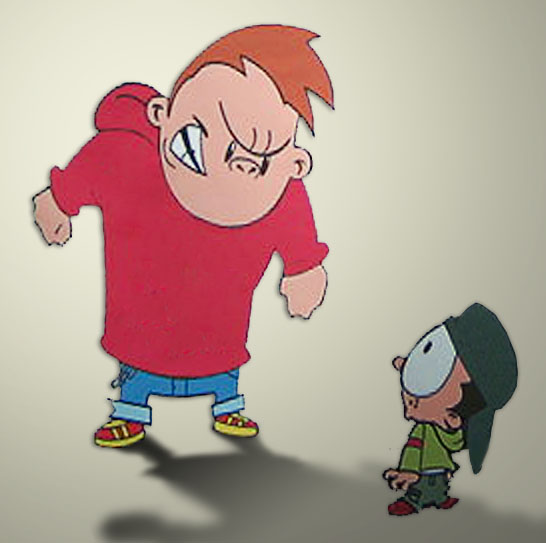
The result was a little bit scary.  The groups started to hate each other.  It started off with names like “sneak”, “cheat”, and “stinker” but soon developed into cabin raids, flag-burning, and even one Eagle telling another to brush the “dirt” of his clothes after bumping into a Rattler.  There was some serious xenophobia (fear or disgust for the “other” or “alien”).  The experimenters stopped the activities for fear of escalation to serious violence and started to think about how they might eliminate this extreme prejudice.

The crazy part is that these were all “normal” boys who didn’t know each other beforehand and had no reason to hate each other besides that their groups (that had also only been formed weeks ago) were in direct competition.

The experimenters tried to bring the groups together at mealtimes and for positive evening activities, but that only served to escalate the hatred.  They hurled food at each other at dinner time and jostled to be first in line.

What the experimenters tried next was pretty genius.  They got the groups to try and work together to solve problems that affected everyone.  One night the truck that was supposed to deliver food “broke down” so they all teamed up and pulled it out of the ditch with their tug-of-war rope.  Another day, the water supply pipeline broke and they all worked together to find the leak. These superordinate (larger than the group) goals brought the Rattlers and Eagles together.

Inter-group relationships built because of these events and at the end of the camp, some campers asked to mix up the busses and one group that had won $5 in a competitive contest offered to buy milkshakes on the ride home for the whole group.  How nice.  They had been reconciled as easily as they had been set against each other.

A 1997 study showed how this sort of reconciliation can be contagious.  It isn’t just people who have friends in other groups who will be more likely to be empathetic.  If you know someone who has friends in another group, you will be more likely to be nice to people in that group.  Sounds a bit complicated, but basically if you have a friend who is a clown, it’s not only you who will be more likely to not hate clowns, but also all of your friends.  As soon as a few Rattlers got to thinking that maybe the Eagles weren’t so bad, the positive feelings probably spread pretty quickly.

Chemical Basis for Xenophobia

But what was going on in their brains to make this happen?

Don’t worry, the kids weren’t lobotomized to find out.

A 2010 Dutch study out of the University of Amsterdam showed that Oxytocin, the “cuddle chemical”, might have something to do with it.

Research subjects who had ingested some Oxytocin were more “ethnocentric” than their placebo-munching counterparts.  People with a bit of extra Oxytocin in their systems were more likely to say they would sacrifice the lives of many outgroup members to save the life of one ingrouper and associated more positive, human words with ingroupers and more negative, dehumanizing words with outgroupers.

The Robber’s Cave Experiment was one of the first field experiments in social psychology.  It inspired Philip Zambardo’s Stanford Prison Experiment and Stanley Milgram’s Obedience Experiment.  It pushed people to consider why they acted in bigoted ways and showed how easy it can be to both turn people on each other and bring them back together.  When we mistreat people who belong to different racial/social/economic groups, are we really being any more than rational than the Eagles and Rattlers? No, we aren’t.

To find out more about the Robber’s Cave experiment, read this summary article by the leader experimenter, Muzafer Sherif, and this webpage.

Muzafer Sherif is also famous for a series of studies using an interesting phenomenon known as the autokinetic effect.  he showed that people will create group norms and stick to them even when the group is taken away.

W is for Wasps

It’s summer time.  And you know what that means? Sure, summer means picnics, barbecues, and sun.

But it also means the coming of the most dreaded outdoor villains: wasps.

Some people freeze up when they see the stripey serial stingers, others try to wave them away.  I prefer the stoic strategy of a short, sharp yelp followed by a crazed hand-waving motion.  It’s not a conscious decision, nor one that I am proud of, but the wasps seem to get the idea that I don’t want them around.

What is a wasp?

Wasp_morphology.svg
Image by Stannered

In taxonomic terms, a “wasp” is any member of the suborder Apocrita that isn’t a bee or an ant.  While that may help useful for biologists, it doesn’t really tell us anything about the creatures.

Wasps are a varied group of hairless, six-legged flying insects that measure anywhere from to 1mm (Fairy Wasp) to 4.5cm (Japanese Hornet).  There are thousands of species of wasp, many of which are specially adapted to feed on and parasitize insects we would regard as pests.

Parasitism

And the way they parasitize those pests can be cruel indeed.  Some parasitoid wasps lay their eggs inside their prey, only to have the eggs hatch a few weeks later, letting their young eat their way out of the unsuspecting caterpillar that has been feeling a strange itch recently.

Other wasps lay their eggs inside plants, genetically modifying a plant’s seeds to suit the wasp’s needs.

Still other inventive wasps have figured out that they can lay their eggs in the nests of other wasps and trick another queen into raising their young.

It seems there is nothing a wasp won’t lay its eggs in.

Fighting Wasps

Not all wasps are content merely laying eggs in unusual places.  Some have acquired a taste for honey.

Meet the Japanese Giant Hornet.

While European honeybees haven’t developed defenses, asian honeybees have discovered a way to fry invaders.

So while you may just think of them as a nuisance when you’re trying to enjoy your picnic, remember that with wasps, there is more than meets the eye.

V is for Vitruvian Man

VitruvianThis drawing, of a man contained within a circle and a square, is one of the most recognizable in the world.  It seems to fascinate people and has a way of transcending time and space to connect with its viewers.  It also is really easy to parody.

The original document, pictured above and created by Leonardo Da Vinci, has two major components: the drawing itself, and two paragraphs of writing.  Both deserve some attention, because while this image is rather commonplace in our culture, most people don’t realize how many layers there are.

Vitruvius

First off, why is the drawing even called the “Vitruvian Man”?  Is Vitruvius a place or something?

That was my first thought, but it turns out that Vitruvius was a man.  Vesuvius = volcano, Vitruvius = man.

Vitruvius was a roman architect whose ten-part treatise on architecture, De architecura, was the only document about architecture to survive from antiquity.  This means we owe much of our knowledge of the theory behind Roman aqueducts, central heating, and water pumps to this book. It is also the source of the (possibly apocryphal) story of Archimedes, his discovery in a bathtub, and his shout of “Eureka!”.

Vitruvius held that the three basic elements of good architectural design were strength, functionality, and beauty.  These elements are so important that they remain mainstays of modern architectural theory.  He was also especially interested in proportion.  He believed that ‘beautiful’ proportions were those based on nature.  And what more perfect example of nature was there than Man?

He believed that a perfect male body would fit the following conditions and that these proportions could be used to design perfect buildings.

For if a man be placed flat on his back, with his hands and feet extended, and a pair of compasses centred at his navel, the fingers and toes of his two hands and feet will touch the circumference of a circle described therefrom.

And just as the human body yields a circular outline, so too a square figure may be found from it. For if we measure the distance from the soles of the feet to the top of the head, and then apply that measure to the outstretched arms, the breadth will be found to be the same as the height, as in the case of plane surfaces which are perfectly square.

-Vitruvius’ De architectura

And then his writings were lost for more than a thousand years.

They were re-discovered in the 1400s in Italy and gained traction amongst Renaissance artists.

The drawing

And which Renaissance artist should be more intrigued by the challenge of drawing Vitruvius’ man than Leonardo Da Vinci, the namesake of everyone’s second favourite Ninja Turtle?

It's ok Leonardo, you may be my second favourite Ninja Turtle, but you'll always be my favourite Renaissance painter.
It’s ok Leonardo, you may be my second favourite Ninja Turtle, but you’ll always be my favourite Renaissance painter.

Da Vinci realized that in order for Vitruvius’ description to work, the centre of the square needed to be lower than the navel.  This lateral thinking separated Leonardo from other artists whose attempts to keep the same centre for both shapes made their men look strange.

cesariano-vitruvius-1 De_Architectura030

The other thing that separates Da Vinci’s Vitruvian Man is the dual positioning.  It gives a sense of movement to the piece as if it is an early kind of animation.  One unfortunate consequence of this is that the drawing doesn’t render very well in 3D and looks kind of like an alien:

An alien through the trees!  Image by Matt Brown
An alien through the trees! Image by Matt Brown

The writing

The drawing itself certainly draws a lot of attention, but few take the time to look at the writing.  This is partially because it is in illegible script, and the script is triply illegible to me.  First of all, I’m just bad at reading old, faded cursive script.  Second, it’s in Italian and I don’t understand Italian. Third, and most interestingly in my opinion, it’s written in mirror writing.  Why he did this is unknown, but it might have helped him avoid smudging as he wrote with his left hand.

The content of the paragraphs describe all of the proportions present in the drawing.  For Da Vinci (and Vitruvius), the distance between the tip of the fingers and the elbow is called one cubit and it is exactly six times the width of a palm and one quarter the height of a person.

There are 15 such proportions below that I encourage you to try out.  How do you measure up to the Vitruvian Man?

  • the length of the outspread arms is equal to the height of a man
  • from the hairline to the bottom of the chin is one-tenth of the height of a man
  • from below the chin to the top of the head is one-eighth of the height of a man
  • from above the chest to the top of the head is one-sixth of the height of a man
  • from above the chest to the hairline is one-seventh of the height of a man.
  • the maximum width of the shoulders is a quarter of the height of a man.
  • from the breasts to the top of the head is a quarter of the height of a man.
  • the distance from the elbow to the tip of the hand is a quarter of the height of a man.
  • the distance from the elbow to the armpit is one-eighth of the height of a man.
  • the length of the hand is one-tenth of the height of a man.
  • the root of the penis is at half the height of a man.
  • the foot is one-seventh of the height of a man.
  • from below the foot to below the knee is a quarter of the height of a man.
  • from below the knee to the root of the penis is a quarter of the height of a man.
  • the distances from below the chin to the nose and the eyebrows and the hairline are equal to the ears and to one-third of the face.

To learn more about this topic, watch this BBC documentary (part 1, part 2) on the subject that inspired this post.

U is for Ununoctium and the Island of Stability

Quick, without looking it up: how many elements are there on the periodic table?

If I had asked that question before the first hydrogen bomb exploded in 1952, the answer would have been 98.   In that year, humans succeeded in synthesizing the first element that the crucibles of stars and supernovae hadn’t supplied to Earth: Einsteinium.

Boom.  Image public domain
Boom. Image public domain

Since then, we’ve been busy bees, building bigger atoms by smashing protons and neutrons together.  63 years after the first atoms of Einsteinium were made off the coast of an atoll in the Pacific and according to the International Union of Pure and Applied Chemistry (IUPAC), there are 114 official, named elements.  Those 16 additional elements were not easy to make, but we’re far from done.

I want to tell you the story of the outer reaches of the periodic table. The tale involves magic (no, seriously… there’s an important concept called magic numbers) and a legendary island in the midst of a terribly unstable sea (again, not just metaphors here… Chemists have theorized of an island of stability that lies in the midst of a sea of instability), but the edge of the chemical world is dark and full of terrors.  Before making our way to the brink, I need to prepare you with the tools you need to wade out into the sea of instability to find the island of stability.

Always have to be careful in the world of chemistry.  Image by Eliot Phillips
Always have to be careful in the world of chemistry. Image by Eliot Phillips

So what is an “element” anyways?

Atoms, the basic building blocks of matter, are made up of electrons whizzing around in clouds around central nuclei.  A nucleus is made of positively charged protons and neutrons without a charge. An atom is said to be a particular element because of the number of protons it has.  If an atom has one proton, it will be called hydrogen.  A hydrogen with extra neutrons or electrons will still be hydrogen, but as soon as another proton is introduced, you’ve gone and made yourself a helium.

A cartoon of an atom with electrons in black, neutrons in blue, and protons in red.
A cartoon of a Lithium atom with electrons in black, neutrons in blue, and protons in red.

In that sense, atoms are just like me with breakfast: change up the cereal or the fruit but touch the coffee and I turn into a whole different person.

At this point you might be asking yourself what the point of neutrons or electrons is if they have no effect on the name of an atom.  The utility of electrons is pretty obvious: the tiny, whizzing balls of negative charge allow atoms to bind together and, because atoms are mostly empty space, their mutual repulsion is what gives matter the illusion of being solid.

Neutrons and Why We Need Them

The role of neutrons is a little bit less obvious.  They have almost all the same properties as protons (same mass, same size, made up of quarks) but lack a charge.  This similarity but lack of charge keeps them subject to the strong nuclear force, just like protons, but avoids the electromagnetic force.  The strong force acts only at very short distances and, like its name suggests, is very strong.  The electromagnetic force, like Paula Abdul suggested in the 80s, acts to keep like charges apart and opposite charges together.

That means protons have a problem if they want to live together in a nucleus.  Protons are by definition positively charged and would be repelled by each other if it were up to the electromagnetic force alone.  This is where neutrons come in.

Neutrons act like nuclear glue: they exert extra strong nuclear force pressure to keep protons together without any electromagnetic effects.  Small nuclei don’t need much glue: Helium has 2 protons, 2 neutrons; Lithium has 3 protons and 4 neutrons.  Bigger nuclei need a lot more glue (e.g. gold – 79 protons, 118 neutrons, lead – 82 protons, 126 neutrons).

Charting the Nuclear Waters

The question soon became: how big can we go?

It has long been known that any element with more than 82 protons (anything past lead on the periodic table) will be inherently unstable.  It will decay radioactively by shedding protons and neutrons until a stable configuration is reached.

Radioactive elements are still elements, though.  They just don’t stick around for as long.  Typically, heavier atoms are less stable.  Just ask Livermorium, whose atoms have a half-life of only 60 milliseconds.

If you start to graph the stability of atoms according to their number of protons and neutrons, it quickly becomes apparent that larger nuclei need proportionally more neutrons to be stable.

asd
The black line at 45 degrees shows when proton numbers = neutron numbers. The black dots are stable nuclides. Past 82 protons (lead), there are no more permanently stable nuclides.  Image by Sjlegg

Some scientists think there could be as many as 7000 different nuclides (combinations of protons and neutrons) that would be stable enough to observe, if only for a fraction of a second.  We currently know of 3000.

Another trend that scientists noticed is that there appears to be particular numbers of neutrons or protons that make for unusually stable atoms.  Those numbers, as of 2007, are 2, 8, 20, 28, 50, 82, and 126.  They have been dubbed “magic numbers”.  Atoms with a magic number of protons and a magic number of neutrons, like Helium (2 and 2) or Calcium (20 and 20) are said to be “double magic”.

The Island of Stability

In the 60s, it was suggested that beyond the current range of the periodic table lies a set of theoretical atoms that could be very large and very stable.  With a “magic” number of protons and neutrons, the atomic components could be arranged in just such a way as to maximize the glueyness of neutrons and spread out the repulsion of protons.

The fabled island itself.
The fabled island itself.  Image by InvaderXan

The metaphor was so vivid that it soon became adopted and has been used ever since.  Scientists even talk of landing on the shores of the island, but its oases still lie undiscovered and unspoilt.

Ununoctium

Before they were confirmed to be synthesized in the lab, the edges of the periodic table were given temporary names according to a set of naming conventions.  These rules are a strange hybrid of greek and latin roots for the element’s number.

The most recent transition from lati-greek to English and official additions to the periodic table were Flerovium (element 114, previously ununquadium – quad is latin, tetra would be greek) and Livermorium (element 116, previously ununhexium – hex is greek, sex would be latin).

The synthesis of element 117, Ununheptium, was announced in 2014, but IUPAC is still reviewing the findings.  The chemistry world continues its search for Ununoctium and speculation about its properties varies from unusually stable to unusually reactive.

One thing is for certain: when it is synthesized, it won’t last long.

T is for Tardigrade

By Jonathan Farrow from the Thoughtful Pharaoh 

Boil ’em, mash ’em, stick ’em in a stew.  They’re versatile!

No, I’m not talking about taters.  I’m talking about tardigrades: quite possibly the most durable creatures on Earth.

They might also be the strangest combination of cute and terrifying anybody has ever seen looking through a microscope.

Cute and terrifying.  Image by Abribus
Meet the water bear.  Strange combination of cute and terrifying. Image by Abribus

Tardigrades, also known as water bears, evolved 500 million years ago.  They have survived on a diet of moss and lichen since around the time the first fish evolved and shortly after animals evolved at all.  While their basic body plan hasn’t changed much, they haven’t been evolutionarily idle.  They’ve developed some pretty neat adaptations (some of which will be discussed below) and diversified into over 1000 unique species. One thing all of these species has in common is size: all species of tardigrade measure between 0.1-1 millimetre (comparable to the size of a single salt crystal).

The amazing thing about these itty-bitty balls of chitinous cuticle is that they can withstand pretty much every type of extreme we can cook up.  They’ve been boiled to over 150 degrees celsius without breaking a sweat.  They’ve been frozen to -250C and didn’t need tiny parkas.  They’ve been dipped in acid, shot into space, dried out, and zapped with thousands of times the lethal radiation dose for a human and they just kept chugging.

Why won't you die!? Image by Frank Fox
Why won’t you die!? Image by Frank Fox

Why are we being so cruel to these tiny creatures?  Because they keep surviving.  Things that terrify us and would kill almost any lifeform barely even faze them.  Tardigrades have expanded the notion of habitable environments and understanding their indestructibility has profound implications for both earthbound medicine and for life on other worlds.

I think tardigrades are pretty darn cool.  This is likely due in no small part to the fact that the lab where I did my thesis in undergrad was home to a healthy colony of moss-eating tardigrades.  Up on the third floor of the Life Science Building at McMaster University, my former supervisor, Dr. Stone (or Doc Roc as he likes to be called) has been testing tardigrade tolerances with Taru, his PhD student.

“Ewww, you can see all of its insidey bits” – Me, the first time I looked at a tardigrade through a microscope. Image by Daniel Adrian Ciobanu, Krzysztof Zawierucha, Ioan Moglan, and Łukasz Kaczmarek.

I got in touch with Doc Roc this week to ask him a few questions about tardigrades.  To give you an idea of the kind of (awesome) professor he is, one of his research goals was to publish a one-sentence paper.  He accomplished that goal with the help of quite a number of semi-colons.  As you’ll see below, I think he likes that useful but oft-forgotten punctuation mark.

Thoughtful Pharaoh (TP): Where do you find tardigrades?

Doc Roc (DR): Tardigrades are found the world over, literally on all continents and in all bodies of water; they inhabit all systems, marine, freshwater, terrestrial; they occur terrestrially on moss.

[They’re everywhere!]

TP: What have you done to test the limits of tardigrades?

DR:  We have tested their tolerance to temperature (cold), radiation, desiccation, pH, g-forces (simulated), and red food dye (I think that you know the tale); we have witnessed complete revival from -80 degrees Celsius for up to 6 months (but they can tolerate -250 K); 4000 Gy radiation (6 Gy kills humans); completely drying out inside an evaporating water droplet (tales in the literature purport over 100 years in a desiccated state); over 16000 g (Earth atmosphere being 1 g – meteoritic impact being an order-of-magnitude greater, however); and sensitivity to red food dye.

[The tale of the red food dye: In one of many discussions of tardigrades in that lab, I was asking if these incredible creatures had any weaknesses.  Doc Roc told me about a curious incident that happened when he tried to stain tardigrades to see them better.  He tried putting some red food colouring onto the plate and they changed colour and were easy to spot, but they also all died. Green and blue food colouring did nothing, but red colouring stressed the tardigrades to death.  Strange that such an indestructible creature could be undone by food colouring.]

TP: What is the most interesting thing about tardigrades, in your opinion?

DR: I think that understanding how their tolerance and reproductive modes (e.g., parthenogenesis) evolved are the most interesting topics for tardigrade research.

[Tardigrades don’t need males to reproduce.  Females can lay unfertilized eggs which will hatch as clones, genetically identical to the mother.  The advantage of this is that they don’t need to waste time looking for mates. The disadvantage is low genetic diversity.]

TP: What do you want to do next?

DR: We plan to investigate how they tolerate the high radiation doses (e.g., their DNA repair mechanisms).

[McMaster has a small nuclear reactor on campus, which has been used in recent years to expose tardigrades to high levels of radiation.  After thousands of times a lethal radiation dose for humans, the tardigrades were fine and in some cases the irradiated ones did better than their lab-housed control counterparts.  How they can survive and continue to reproduce remains a mystery but it almost certainly involves some incredible DNA repair.]

TP: Do you ever name the tardigrades?

DR: The student who studies them is named Taru, which seems an appropriate name for one; given that we work with a parthenogenetic species, I would name them Tarugrade 1, Tarugrade 2, …

[Seems reasonable to me.]

TP: If they’re so invincible, why haven’t tardigrades taken over the world?

DR: Organisms are limited in their resources, so populations can grow unchecked only to the extent that living materials are available (populations crash thereafter); predators additionally can reduce population sizes.

[In other words, tardigrades can still starve and get eaten.  Just like every other creature.]

TP: What can studying tardigrades tell us about life on other planets?

DR: Studying tardigrades can inform us about the limits to which organisms can survive, helping researchers to identify which extreme environments are viable and whether organisms could be transported between planets.

[The theory that life arrived here from another planet (called panspermia) is not as crazy as it sounds.  I wrote a bit about it a while ago.]

Thanks Doc Roc!

If you have any other tardigrade questions, feel free to comment below and be sure to share this with your friends. Spread the water bear word and let us not be frightened of our tardigrade overlords!

Tardigrade 1
This guy looks like he’s ready to partygrade. Image by the Goldstein lab.

If you want to learn more:

  • The BBC recently published a pretty comprehensive article about these resilient little critters here
  • TARDIS was a European mission in 2007 to see how well they survived in space
  • A (bearded!?) Hank Green produced a video about them for SciShow in 2012.

S is for Simple Rules

By Jonathan Farrow from the Thoughtful Pharaoh

Consider the following: schooling fish, roundabouts, segregation, and human consciousness are all examples of the same fundamental property of the world.  It may seem crazy to suggest that roundabouts may be interesting in some sense, but bear with me.

The property in question, and this week’s topic, is emergence.  In each case individual entities, by following simple rules, can create complex patterns of behaviour.  What makes these patterns special is that they can’t be predicted based on the simple rules alone.

Swarms

If you’ve ever seen a murmuration of starlings, you have probably found yourself wondering how that many birds (upwards of 100,000) can all fly so quickly in such close proximity without hitting each other.  For those of you uninterested in ornithology (the study of birds), there are also plenty of examples of swarms in entomology (the study of insects) and ichthyology (the study of fish), and even chiropterology (study of bats).

Image by SteveD
Image by SteveD

In each case, the animals are unaware (and frankly, uncaring) of the beautiful shapes their swarms make.  They aren’t even trying to swarm.  They are trying to survive and their instinct tells them to follow a few simple rules.  Since the advent of computers, scientists have been trying to find out what those rules are.

One of the most famous computational models of swarming behaviour was proposed by Craig Reynolds in 1986.  In his Boids program, simulated birds had to follow three rules:

  1. Separation: Don’t crash (steer away from nearby boids).
  2. Alignment: Get with the program (steer towards the average heading of nearby boids)
  3. Cohesion: Don’t get lost (steer towards the average location of nearby boids)

This model is actually a really good model for the behaviour we observe in birds and fish.  Recent studies have also shown this alignment rule is especially important for bats.

Locusts, on the other hand, seem to have a much simpler set of rules.  Locusts just want to avoid getting their backsides eaten.  When approached from behind, locusts will tend to fly forward for fear of cannibalism.  This creates an overall tendency to move forward and can lead to giant swarms.

Image by CSIRO
Image by CSIRO

Roundabouts

If you’ve ever been to Swindon (and, from what I hear, you’re not missing much if you haven’t), you might have come across quite possibly the most offensive piece of civil engineering in the UK.

That's right.  A giant roundabout.  Image in the public domain
That’s right. A giant roundabout. Image in the public domain

As a North American, I cringe at the thought of even a tiny roundabout but Swindonians apparently hate everything that is good in this world.

They built the Magic Roundabout.  A terrifying series of 6 small roundabouts encircling a larger roundabout that goes the other way.  If that sounds confusing, it’s because it is.

The more confusing part, however, is that hundreds of thousands of cars pass through it unscathed.  While there is certainly a lot of anxiety about it, there have been only 14 major accidents in 25 years.

Hell for North Americans.  Image from the BBC
Hell for North Americans. Image from the BBC

The vast majority of people pass through fine, despite there being 5 different entry and exit points and many conflict points (places where streams of traffic cross).  This happens because of a few simple rules:

  1. Follow the lines
  2. Give way to cars coming from the right
  3. Drive to where you want to go
  4. Don’t crash

Apparently it’s actually an effective way to move cars through an intersection, but my North American sensibilities just can’t handle it.

For more information on this piece of crazy road engineering, visit this explanatory page and watch this video.

Segregation

Choosing who you associate with based on a singular trait has been known to lead to a lot of issues in the past.  As a dog person, I’ve lost a lot of friends to cats (and their parasites).  Despite my friendly demeanour and my ability to put up with a fairly large proportion of cat-lovers in my immediate vicinity, at a certain point I start to feel uncomfortable and want more fellow dog-lovers.

Tensions flare.  Image by Peretz Partensky
Tensions flare. Image by Peretz Partensky

In 1971, Thomas Schelling set out to model this behaviour and came out with a somewhat surprising and scary result.  Even when people are fine with being in the minority, if they are dissatisfied when surrounded by a large majority of “others”, they will tend towards segregation.  The model followed a few simple rules:

  1. If you are surrounded by a certain percentage (e.g. 30%) of similar people, you are satisfied
  2. If you are surrounded by a certain percentage of different people (e.g. 70%), you are dissatisfied
  3. If you are dissatisfied, move to somewhere where you are satisfied.

Within a few rounds, there is very little diversity left as people tend to move towards those who are similar.  This, despite the fact that no individual is saying they outright dislike the other group or couldn’t live with members of the other group.  This model helps to explain why segregation is so hard to eliminate.

Interestingly, this tendency towards segregation can be reversed if a maximum of similar people rule is added:

4. If you are surrounded by a certain percentage of similar people (e.g. 90%) you are dissatisfied

Again, complex patterns and simple rules.

To learn more about the model, go here.

Conciousness

There are approximately 100 billion neurons in an adult human brain.  These neurons are connected in intricate ways to create an estimated 100 trillion connections.

Now that's a lot of connections!  Image from Wikimedia
Now that’s an impressive set of connections! Image from Wikimedia

Somehow (and to be honest we’re not really sure how yet), these connections lead to all of our brains’ activities from thought to imagination and memory.  The abilities of the system (the brain) couldn’t possibly be known from the rules that neurons abide by.  All that a neuron does is pass on its signal according to a set of rules.  We still don’t know what those rules are.

We do know that when a neuron is activated (whether by electrical or chemical stimulation), it activates other neurons.  The precise number and location of these other neurons is still a big mystery in neuroscience, but it must be activating both nearby neurons and neurons on the other side of the brain.  This dual activation of long- and short-distance connections is what creates the sustained patterns we observe in fMRI scans.

Human Connectome Project
The Human Connectome Project, kind of like the Human Genome Project before it, is setting out to map all of the brain’s 100 trillion connections to better understand how it works.  Image by Xavier Gigandet et al.

While I don’t mean to suggest that everything in life can be boiled down to simple rules, I think it’s pretty incredible the patterns that emerge from individual actors all playing their parts.

R is for Ratzilla

An excerpt from my favourite scene in the 1987 film, the Princess Bride:

Westley: Rodents of Unusual Size? I don’t think they exist. [R.O.U.S. attacks Westley] Westley: Ahhhh!!!

Why is that my favourite scene?  Because I laugh every time I watch it. The R.O.U.S. is just so ridiculous-looking and shows up right after Westley disbelieves its existence.

For the devoted readers out there, you’re maybe wondering what my obsession with R.O.U.S.es is, because I’ve written about them before, but somehow they capture my imagination unlike any other strangely-proportioned creature.  I think it has something to do with the comedic effect of reversing the expectation of something cute.

Rodents of Unusual Size: They do exist. Image from the Princess Bride
Rodents of Unusual Size: They do exist. They are definitely not cute.  Image from the Princess Bride

The R.O.U.Ses from the Princess Bride have come to set the standard for overgrown rodents, but sometimes reality is stranger than fiction.

The largest discovered member of the rodent family (membership to which depends on having a pair of razor-sharp, ever-growing incisors), Josephoartigasia monesi is estimated to have been the size of a bull.

.

Reconstruction of head
A reconstruction of J. monesi’s skull based on the bones that were recovered. Image by Andres Rinderknecht & Ernesto Blanco

Since only its skull was discovered, the  weight of this creature has been debated.  The original discovery paper pegged the mass of the monstrous mulch muncher at 1211kg on average with a maximum of 2584kg. To put that into perspective, that’s anywhere from 1 to 4 dairy cows.  A more recent study, however, showed that depending on the part of the skull you use to predict the mass of the full creature, J. monesi could have weighed from as low as 356kg (half a cow) to 1534kg (back up to the 2-cow range).  Even if the creature was as small as 356kg, that still makes it nearly 6 times heavier than the current rodent heavyweight champion of the world, Floyd Mayweather the capybara.

In any case, it’s definitely big enough for a recent Science Magazine article to correctly use the term “Ratzilla”.

Rodents of Unusual Size: They do exist.  Image from the Princess Bride
RATZILLA!!!  Image by James Gurney

Ratzilla’s bite force was recently estimated up to 4000N, enough to outperform modern crocodiles and tigers.  It was definitely a herbivore though, and is thought to have used its teeth as elephants use their tusks: to dig around for tasty treats.

Luckily for us, Ratzillas (Ratzillae?) no longer roam the plains of South America.  They went extinct about 2 million years ago, after 2 million years of rodent dominance.  Interestingly, that makes them the contemporaries of terror birds, sabre-toothed cats, and giant ground sloths. Their size and sharp teeth probably made them tough prey items.

Just like the R.O.U.Ses in the Princess Bride though, they were probably susceptible to fire jets and swords.

And with this rodent rant written, I promise to not write about any more Rodents of Unusual Size for the remainder of this ABCs series.

Q is for Quokka

What’s half a metre long, weighs 3-4kg, and has the cutest face you ever did see?

Cat_Cute
Image by Gaurav Pandit

Nope, cuter.

Cute_beagle_puppy_lilly
Image by Garrett 222

Even cuter.

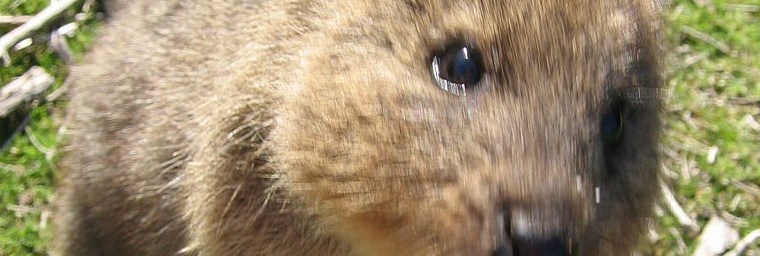
Quokka Cute
Image by Jin Xiang

Yup, there it is!  This, dear readers, is a quokka.  A native of South west Australia, this marsupial has recently skyrocketed to fame because of the way its mouth seems to rest in an adorable little smile.  A quick Google image search will reveal hundreds of awesome pictures (that aren’t licensed under creative commons) and a growing number of quokka selfies.  It looks so happy that it has even been dubbed the mortal enemy of Grumpy Cat.

So, what’s the deal?

The quokka is a vegetarian (one of those darn salad-eaters) that prefers leaves and stems.  Since its habitat is so dry, it will swallow its food whole only to regurgitate it later, chew it up, and swallow again in order to make sure it sucks out all of the moisture.  Their digestive systems are tuned to allow survival in the dry climate of Western Australia.  This means that when humans try to feed the quokkas with bread or give them water, the poor animals can go into toxic shock and die.  For the love of all that is cute in this world, do not feed quokkas.

I'm fine with my flower.  I don't need your charity! Image by Vicsandtheworld
I’m fine with my flower. I don’t need your charity!
Image by Vicsandtheworld

Like other marsupials, quokkas have a very short pregnancy of only one month, followed by five or six months of pouch-time.  Unlike most other marsupials, quokkas have the ability to double down on their reproduction.  The day after giving birth and moving the joey to their stomach pouch, female quokkas will mate again and will pause the development of the new foetus in a process known as embryonic diapause.  If the joey in the pouch doesn’t make it (quokka-god forbid), the female can resume the embryo and still call the season a reproductive win.

One thing the quokka’s PR people (who have done an excellent job so far, by the way) might not want you to know is that female quokkas, when threatened by predators, will quite literally throw their babies under the bus.  They will eject their joey and head for the hills, hoping that the predator takes the easy prey and they get to live another day.

Image by Hesperian
A nice, happy quokka family.  That obviously didn’t resort to infanticide in the case of this joey.  Doesn’t Nature just suck sometimes?  Image by Hesperian

For the readers out there still keen to snap the perfect selfie, the best place to find quokkas is on Rottnest Island, a tiny, 19km2 bit of land off the coast of Perth.  [Non sequitur – I can’t help but hear “Purse” said with a lisp whenever I come across Perth.]  The island was named Rottnest (Rat’s Nest) by a dutch explorer who thought the resident quokkas looked like “a kind of rat as big as a common cat”.

Just like the selfie stick we know is lurking out of the frame of all those hilarious pictures, disaster may be around the corner for the quokka.  The Australian Government rates the Rottnest Island population as stable, but the quokka’s mainland habitats are under threat from foxes (an invasive species) and forest clearing.  These threatened mainland populations are especially important because they contain much more genetic diversity than the island groups.  The IUCN classifies the quokka as Vulnerable, one step above Endangered.  This is due not to the population size (upwards of 10 000), but rather to the extremely small range and susceptibility to environmental change.

The quokka's range is quite limited.
The quokka’s range is quite limited.

The quokka is a species of very cute and biologically strange marsupial whose Australian home is under a myriad of threats.  Why the internet is currently abuzz with it remains a mystery, but there are certainly some adorable pictures to be taken and some interesting things to be learned.

P is for Plant Defences

By Jonathan Farrow of the Thoughtful Pharaoh

As the great glam metal band Poison sang in 1988, “Every Rose Has Its Thorn“.

Like so many glam metal bands to grace the world’s stages before them, none of Poison’s members were botanists. If they were, they might have known that roses actually have prickles, not thorns.

It’s an easy enough mistake to make.  But because I am a pedant at heart, I want Poison to know that, technically, thorns are modified branches, spines are modified leaves, and prickles are modified skin. That means roses have prickles. I therefore petition that the lyrics of the chorus of the song be changed from:

Every rose has its thorn
Just like every night has its dawn
Just like every cowboy sings his sad, sad song
Every rose has its thorn

to the more scientifically accurate:

Every rose has its prickle
Just like brine turns veggies to pickles
Just like every cowboy is really quite fickle
Every rose has its prickle

Thorn (modified branch) from a citrus plant.
Thorn (modified branch) from a citrus plant. Image by Edgovan22
Spines (modified leaves) from a Pereskia grandifolia (aka rose cactus) plant
Spines (modified leaves) from a Pereskia grandifolia (aka rose cactus) plant  Image by Frank Vincentz
Rose_Prickles
Prickles (modified skin) from a rose bush.  Image by JJ Harrison

But how did plants come to develop all of these different ways to impale gardeners’ fingers in the first place?

To answer that question, let’s imagine a world without thorns, spines, or prickles. No toxins, sap, poisons, or deterrents of any kind.  In a world like that, as long as there were herbivores, plants wouldn’t last long.  They’d get eaten up pretty quick and getting eaten generally isn’t good for your reproductive health (with a few noticeable exceptions *cough* black widow spider *cough*).  So there’s a lot of evolutionary pressure on plants to develop ways to avoid becoming lunch.

Predation from salad-eaters isn’t the only pressure on plants, though.  They also need to compete with other plants around them by growing to capture more sunlight and they need to devote resources to reproducing.  This is called the growth-differentiation balance.  Plants, with limited resources, must choose between straightforward growth and developing specialized defences.  If this theory is true, we would expect plants that didn’t have to worry about getting eaten would be less thorny.  In October 2014, an international team of researchers showed that in an herbivore-free zone, like the favourite hangouts of leopards on an African savanna, non-thorny plants thrive, whereas the thorny plants do best in the favourite hangouts of salad-eating impalas.

Salad-eaters (aka herbivores) don’t just take an evolutionary backseat to this escalation of plant defences.  Ever since the first animals started emerging from the sea and started choosing salad, plants have been trying to send them back and animals have kept coming.  It’s an evolutionary arms race.

And if the Cold War taught us anything, its that arms races lead to some pretty ridiculous specializations.  Here are a few of my favourites on the plant side of things:

Sorcerer Corn

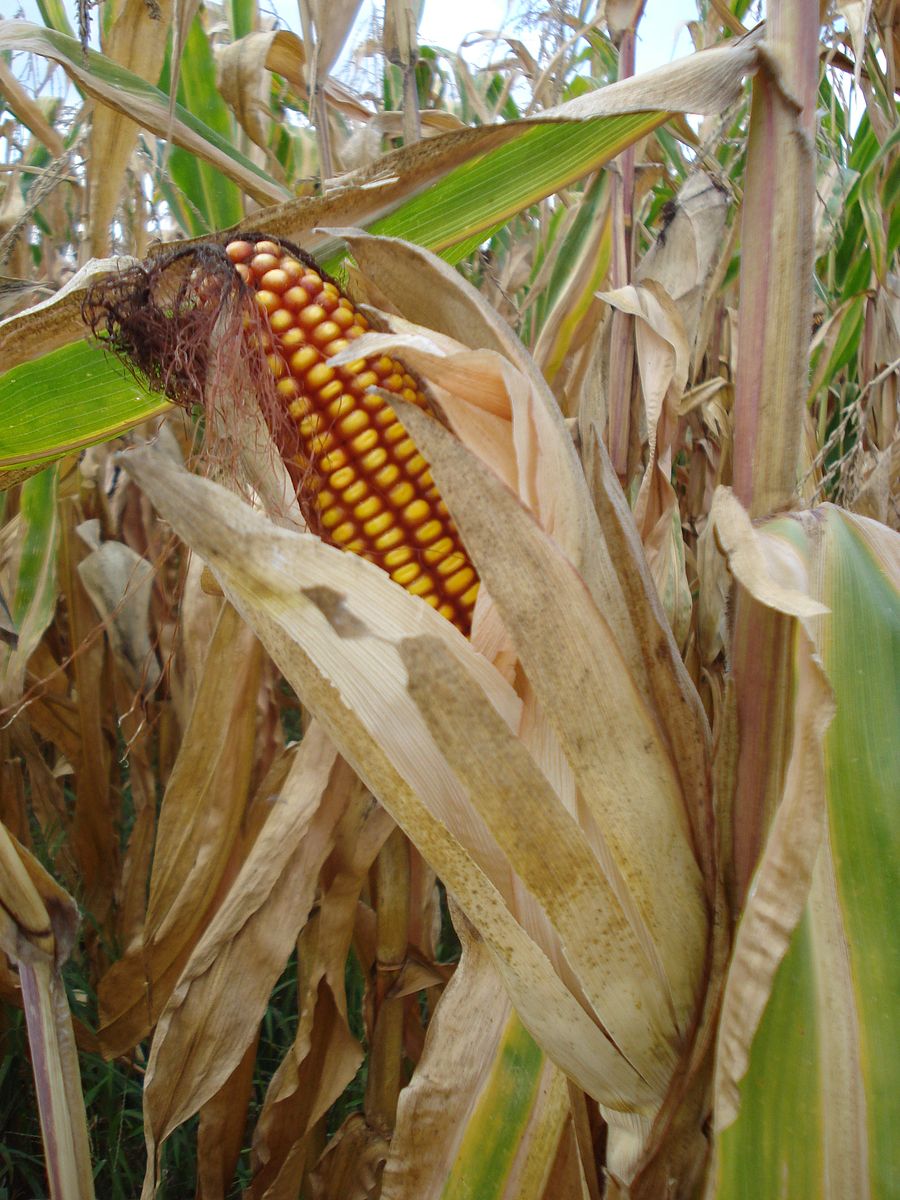
Behold! Sorcerer Corn!  Image by Silverije
Behold! Sorcerer Corn! Image by Silverije

It looks like regular corn.  And that’s because it is.

Regular corn seedlings, when exposed to a chemical in the saliva of beet armyworms, will release a chemical that summons a cloud (or, less dramatically, attracts) parasitoid wasps which will lay eggs inside of the armyworms.  These eggs will hatch after two days and eat their way through the armyworm from inside out.

Corn isn’t the only plant that releases signals like this.  In fact, you know the smell of freshly-cut grass?  That turns out to be the plant equivalent of screaming out to any relatives in the area to “GET READY! THERE’S SOMETHING THAT WILL HURT YOU NEARBY!”

Flinching Flowers

We normally think of plants as stationary things, unable to move.  This is usually true, but there are some plants which have the ability to quickly shut their flowers or droop on contact.  The most famous example of this is the Venus Flytrap, but that is more of an offensive flinch.

Image by Mnolf
Image by Mnolf

Mimosa pudica, or the sensitive plant, also has this flinching (thigmonastic) ability.  When touched, this species will close its flowers and fold away its leaves, thus decreasing its surface area and making it harder to see and eat.

I'm just going to fold away now...
I’m just going to fold away now…  Image by Hrushikesh

Whether its by developing thorns, spines, prickles, the ability to fold up, or the ability to call helpful predators, plants have not been idle in the fight against salad-eaters.  Every rose has its prickles (not thorns!) because of this ancient struggle and while they may be annoying, I guess we should be happy roses haven’t evolved to attract parasitoid bears that will leave cubs inside of our stomachs to gnaw their way out over the course of a week.

Yet.

O is for Ocean Acidification

By Jonathan Farrow from the Thoughtful Pharaoh

We all know that CO2 emissions are warming the planet.  Or at least, most of us do.  What often goes unreported is the effect of carbon dioxide on the worlds’ oceans.  A lot of the CO2  that we pump into the air makes its way to the water and is making it more and more difficult for shelled creatures like sea urchins, lobsters, and coral to survive.

Lobster
This is Bob the lobster. This is his “I’m sad because of the increased levels of anthropogenic carbon dioxide that are making my life harder” face.  Image by Pedrosanch

In order to understand why this happens, we need to go back to secondary school chemistry.

Don’t worry, I’ll make sure Jared doesn’t pick on you.

Jared
No Jared! No!     Image public domain

The first lesson we need to recall is about acids.  What is an acid?

Something that bubbles in a flask?  Image by Joe Sullivan
Something that bubbles in a flask? Image by Joe Sullivan

Acids are compounds that have free hydrogen ions floating around.  These hydrogen atoms are quite reactive, so it means the more free hydrogen you have floating around, the more reactive your compound. Acidity is usually measured in pH, which stands for the “power of hydrogen”.  pH is measured on a scale (creatively named the “pH scale”) that ranges from 0 to 14.

Compounds that get a 0 on the scale are exceedingly acidic, meaning they are made up of pretty much just free-floating Hydrogen ions. Compounds that rate 7 are perfectly neutral, like distilled water. Compounds on the other end, near 14, are called “basic” or “alkaline” and instead of having lots of hydrogen ions to give away, they have all sorts of space for hydrogen atoms.  This makes them reactive because they can strip hydrogen from things that don’t usually want to give it away (like Edward Norton’s hand in Fight Club).

The other confusing bit to remember is that the pH scale is logarithmic, meaning that each number you jump actually indicates a multiplication by 10. For example, something with pH 3 (like soda) is 100 times more acidic than something with pH 5 (like coffee).  This means if a large body of water (like the ocean) shifts by even a small pH number, the effect can be very large.

Image by OpenStaxCollege

The second lesson we need to recall is about equilibrium.

In chemistry, everything tends towards balance. If you combine equally strong acids and bases, they will react together until the result has a pH that is in between.  You might also get a volcano-themed science fair demonstration.

When CO2 combines with water (H2O), they form carbonic acid (H2CO3).  The carbonic acid will break up (dissociate) into bicarbonate (HCO3) and a hydrogen ion (H+).  In a basic environment, the bicarbonate will dissociate further into carbonate (CO32-) and the result will be two hydrogen ions (2H+).

We can visualize this path with a chemical equation:

H2CO3  —-   H+ + HCO3–   —-   2H+ + CO32-

Where this path stops depends on the environment it is in.  In an acidic environment, the balance will tend towards the left, with more hydrogen bound up with the carbonate (because there is no space in the solution for more free hydrogen).  In a basic environment, the balance will tip to the right, releasing more hydrogen and freeing up the carbonate.

Currently, the pH of the ocean sits at about 8.1 (slightly alkaline).  Because of this, there is plenty of carbonate available for creepy-crawly-shellfish to use to build their homes.  Crustaceans and corals combine the free carbonate with calcium to form calcium carbonate (aka limestone, chalk, and Tums). They can’t use bicarbonate (HCO3) or carbonic acid (H2CO3) and find it hard to form anything at all in an acidic environment.

This means that as we add CO2 to the water, we create more carbonic acid and contribute to the acidity of the ocean, dropping its pH.  Not only does this make it hard for the little guys down there trying to make a living, but it also endangers the big chompers that eat the little guys.

The ultimate big chomper.  This is what happens when you jokingly search for
The ultimate big chomper. This is what happens when you jokingly search for “chomper” on wikimedia.

A recent review found that even under the most optimistic emissions scenario, the ocean’s pH is likely to drop to 7.95, affecting 7-12% of marine species that build shells. Under a high emissions scenario, the pH will go down to 7.8, affecting 21-32% of those species.

In order to keep track of the progress of this acidification, researchers from Exeter have proposed using satellites to monitor hard-to-reach bits of the ocean.

Regardless of the pace of the change, scientists agree one thing is certain: the oceans will become less hospitable for shell-builders.  The superficial impact of this for humans will be rising prices on shellfish, but there will be much deeper ramifications throughout marine ecosystems.

And I think we all know who is to blame.

Jared

Thanks Jared.